
Pasteis de Nata
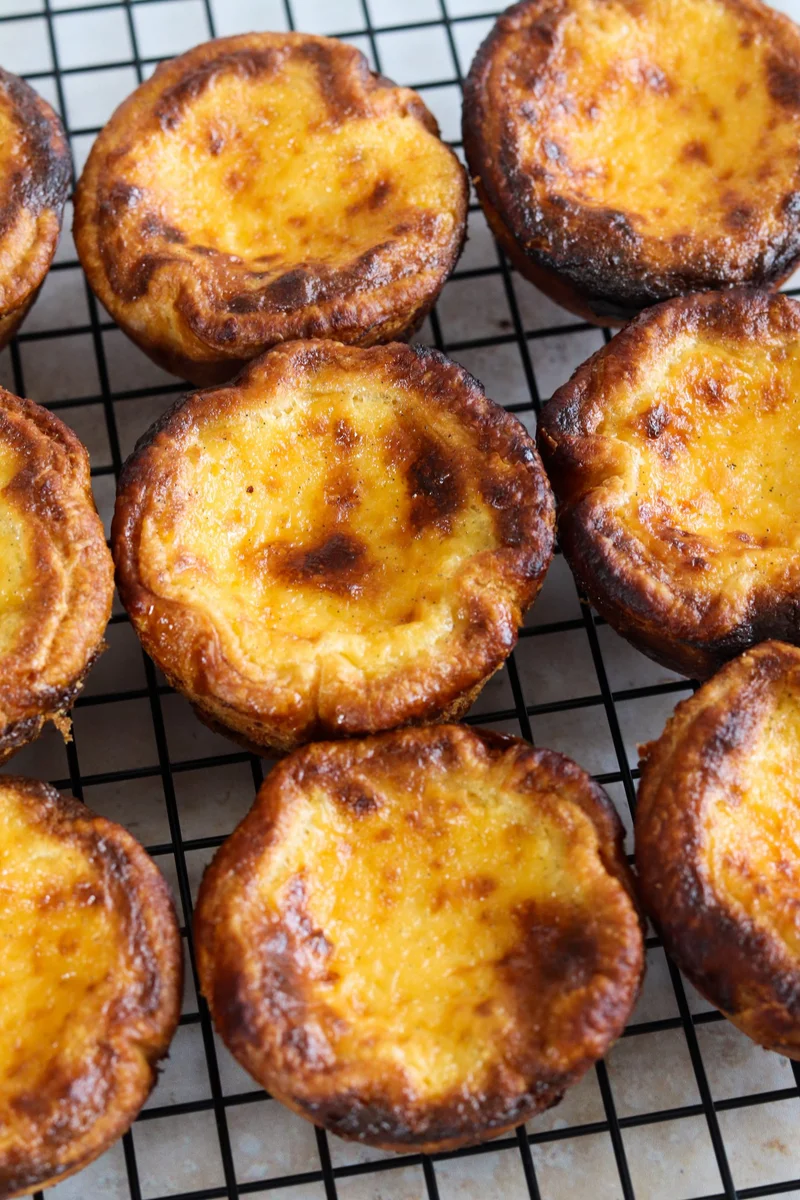
Pastéis de nata are Portuguese custard tarts with crisp, layered puff pastry and a creamy vanilla filling. This version makes 12 individual tarts, with folded pastry edges and the characteristic dark spots on top.
Ingredients
- 375 gpre-rolled all-butter pastry
- 3egg yolks
- 100 gcaster sugar
- 2 tbspcornflour
- 200 mlsingle cream
- 250 ml + 1 tbspwhole milk
- 1/2vanilla pod
- as neededspray oil for greasing
- as neededicing sugar for dusting
Instructions
- 1
Prepare the tin
Heat the oven to 200°C fan-assisted or 210°C without a fan. Grease a 12-hole muffin tray with spray oil and place it in the freezer.
- 2
Roll the pastry
Take the 375 g pastry straight from the fridge and dust it with icing sugar. Roll it tightly into a log along its longest side.
- 3
Cut the log
Slice the pastry log into 12 equal pieces.
- 4
Shape the rounds
Dust each piece with icing sugar and stand it on its cut end, so the pastry layers are visible. Roll each piece into a circle roughly 11 cm across.
- 5
Line the tray
Press each pastry round into a hole in the muffin tray; the edges can remain folded rather than flat. Put the tray in the fridge.
- 6
Whisk the yolks
In a large bowl, whisk the 3 egg yolks with the 100 g caster sugar until creamy.
- 7
Mix the cornflour
Stir the 2 tbsp cornflour into 1 tbsp milk, then whisk this mixture into the yolks. The mixture may look unusual in texture.
- 8
Heat the dairy
Put the 200 ml single cream, 250 ml whole milk and seeds from half a vanilla pod in a pan. Heat until almost boiling.
- 9
Temper the yolks
Take the pan off the heat. Whisk the hot milk mixture gradually into the yolks, adding a little at a time.
- 10
Cook the custard
Pour the mixture back into the pan and heat gently for 3 minutes, stirring continuously.
- 11
Fill and bake
Pour the custard into the pastry cases and bake for 25–30 minutes, until the pastry is golden and dark spots appear on the custard.
- 12
Cool the tarts
Leave the tarts to cool slightly before removing them from the tin.
What are pastéis de nata?
Pastéis de nata are Portuguese custard tarts, made with a flaky pastry shell and a softly set egg custard. They are associated with Portugal and are often served as an individual sweet treat.
This version uses ready-rolled all-butter puff pastry for convenience, shaped into layered rounds, and a vanilla custard cooked on the hob before baking.
Nutrition and macros by portion
The nutrition label shows one serving as written: 269 calories, 2g protein, 11g carbs, 7g fat.
| Portion | Adjustment | kcal | Protein | Carbs | Fat |
|---|---|---|---|---|---|
| Lighter | Smaller tart portion | 188 kcal | 1g | 8g | 5g |
| This serving | As written | 269 kcal | 2g | 11g | 7g |
| Hungry | Two-tart portion | 404 kcal | 3g | 17g | 11g |
The pastry and sugar provide most of the carbohydrates, while the all-butter pastry, cream and egg yolks contribute much of the fat; the yolks also provide some protein. Enjoy a tart with fruit or serve it after a meal that includes vegetables and a source of protein for a more balanced plate.
Shaping the pastry
The log: Rolling the pastry from its longest side creates a coil of layers in each cut piece. Keep it cold as you work so it remains easier to handle.
The rounds: Stand each piece on its cut end to expose the layers, then roll it to about 11 cm across. Press it into the muffin tin without flattening every fold at the edge.
Making a smooth custard
Cornflour: First mix it with a tablespoon of milk, then whisk it into the yolks and sugar. This small amount of liquid helps disperse the cornflour before the rest of the dairy is added.
Hot milk: Pour it into the yolk mixture slowly while whisking. Adding it in stages helps combine the warm dairy and eggs evenly.
Cooking the filling
Gentle heat: Return the combined custard to the pan and stir continuously for the full 3 minutes. Keep the heat gentle so the mixture thickens without catching on the bottom.
Vanilla: Scrape the seeds from half a pod into the cream and milk as they heat. The seeds distribute through the custard and bring vanilla flavour to each tart.
Baking cues
Colour: Bake for 25–30 minutes, looking for golden pastry and dark spots on the surface of the custard. These visual cues are more useful than relying on time alone.
Oven setting: Use 200°C for a fan-assisted oven or 210°C for a conventional oven, as specified in the method. The tray should be cold when the pastry cases go in.
Serving and finishing
Cooling: Let the tarts cool slightly before taking them out of the tin, as the pastry is delicate while hot. Dust with icing sugar before serving if desired.
Pairings: Serve them on their own with tea or coffee, or alongside fresh berries for a bright contrast to the rich custard.
Recipe notes & tips
- Keep the pastry chilled until you are ready to roll and shape it.
- Dust the work surface and pastry lightly with icing sugar to help with shaping.
- Use the cold muffin tray to help the pastry cases hold their shape.
- Add the hot dairy to the yolks a little at a time while whisking.
- Stir the custard continuously during its 3 minutes of gentle cooking.
- Check for golden pastry and dark custard spots towards the end of baking.
Variations
- Cinnamon finish: Dust the baked tarts lightly with cinnamon along with the icing sugar.
- Citrus note: Add a little finely grated lemon zest to the custard for a fresh aroma.
- Extra vanilla: Use a whole vanilla pod for a more pronounced vanilla flavour.
- Berry serving: Offer fresh berries alongside the tarts for a fruity contrast.
Common mistakes to avoid
- Warm pastry: It can become difficult to shape; return it to the fridge until firm.
- Flattened edges: Pressing the pastry too smooth removes its folded look; leave some natural folds around each case.
- Cornflour lumps: Adding it dry to the yolks can make it harder to mix; blend it with the tablespoon of milk first.
- Fast tempering: Pouring in all the hot dairy at once can make the mixture harder to combine; add it gradually while whisking.
- Unstirred custard: It can catch on the pan base; keep stirring throughout the 3-minute cooking time.
- Early removal: Hot pastry cases may break; let the tarts cool slightly before lifting them out.
How to store
Once cool, store the tarts in an airtight container in the fridge and eat within 2 days. Reheat briefly in a warm oven until the pastry is crisp; allow them to cool a little before serving.
Frequently asked questions
Can I use ready-rolled puff pastry?
Yes. This recipe is written for 375 g of pre-rolled all-butter pastry, taken straight from the fridge.
Why does the pastry get rolled into a log?
Rolling it along its longest side creates visible layers when the log is cut. Standing each piece on its cut end keeps those layers in the pastry rounds.
Should the pastry edges be flat?
No. The method says to press the rounds into the tray while leaving folds around the edges.
How do I know when the tarts are baked?
The pastry should be golden and dark spots should appear on the custard. The stated baking time is 25–30 minutes.
Can I make the custard ahead?
The recipe makes the custard shortly before filling and baking the cases. For the best match to the method, prepare it while the lined tray chills in the fridge.
Can I serve the tarts warm?
Yes. Let them cool slightly first so they are easier to remove from the tin, then serve while still warm if you like.
Cook it from the original
This recipe comes from curlyscooking.co.uk. Their page has the author’s own photos, notes and tips — the best place to cook it from.
Open the recipe on curlyscooking.co.uk