
Toasted Sugar Vanilla Bean Macarons with Caramelised White Chocolate German Buttercream
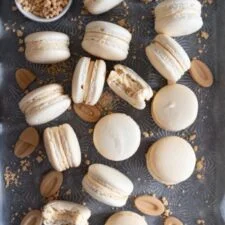
These crisp, almond-based macarons have vanilla-scented shells made with toasted sugar and a rich German buttercream flavoured with caramelised white chocolate. They take care and patience, but make an elegant make-ahead treat for sharing.
Ingredients
- 170 gground almonds
- 300 gicing sugar
- 180 g, at room temperatureegg whites
- 160 gtoasted sugar (see tips for recipe)
- 1 tspvanilla bean paste
- 190 gwhole milk
- 1 tspvanilla bean paste
- 110 gtoasted sugar
- 12 g (1 1/2 Tbsp)cornflour
- 1egg
- 1egg yolk
- 1/2 tspkosher salt
- 340 g (3 sticks), at room temperatureunsalted butter
- 200 g, melted and cooled to room temperaturecaramelised white chocolate (see tips)
Instructions
- 1
Prepare the oven
Heat the oven to 150°C and set a rack in the centre. Use a round cutter or the base of a piping tip about 4 cm across to draw circles on baking parchment, leaving about 2 cm between them.
- 2
Sift dry ingredients
Mix the ground almonds and icing sugar in a large bowl. Sift the mixture twice to remove larger lumps and aerate it, then set aside.
- 3
Whip the meringue
Using a stand mixer with the whisk attachment, beat the egg whites at medium speed until foamy. Gradually add the 160 g toasted sugar, turn the mixer to high and whisk until the meringue begins to firm. Mix in the vanilla, then continue until stiff peaks form.
- 4
Fold in almonds
Take the bowl off the mixer. Add half of the almond and icing sugar mixture and fold it into the meringue, letting out a little air as you combine them.
- 5
Check the batter
Add the remaining almond mixture and fold gently. Continue with turns of the bowl, scooping from the bottom and spreading the batter against the side to deflate it gradually. Lift the spatula to check: the batter should fall in a lava-like stream and form a figure eight without breaking. This takes practice; avoid overmixing, as piping will work the batter a little more.
- 6
Pipe the shells
Fit a piping bag with a medium round nozzle, such as an Ateco #805. Put the circle template on a baking sheet and cover it with another sheet of parchment. Hold the bag upright and pipe rounds to match the circles, finishing each with a small flick of the wrist. Remove the template.
- 7
Release air bubbles
Hold the baking sheet with both hands and tap it firmly and evenly against the work surface several times. This helps pop air bubbles, flatten peaks and spread the rounds slightly.
- 8
Pipe remaining batter
Repeat the piping and tapping with the rest of the batter. The recipe usually fills about three baking sheets.
- 9
Dry the shells
Leave the piped rounds at room temperature for about 30 minutes, or until they have a dry skin that does not stick when touched. The time can vary considerably with humidity.
- 10
Bake the macarons
About 15 minutes before baking, heat an empty baking sheet in the oven. Bake one tray at a time, placing each macaron tray on top of the preheated sheet. Bake for about 18 minutes, turning the tray once and checking from 15 minutes. The shells should form feet without browning. Press a shell lightly: if its foot moves, bake a little longer. When a shell is stable, test whether it lifts cleanly from the paper; if not, bake for another minute or so.
- 11
Cool the shells
Take the tray from the oven and leave the shells on it for 10 minutes. Peel them from the parchment and cool fully on a wire rack. Bake the remaining trays in the same way, reusing the preheated sheet underneath.
- 12
Release stuck shells
If the shells will not peel away cleanly, put them on their parchment in the freezer for 5–10 minutes, then remove them.
- 13
Store the shells
Keep the cooled shells in an airtight container until you are ready to fill them.
- 14
Mix the custard
In a bowl, whisk together the 110 g toasted sugar, cornflour, egg, egg yolk and salt. Heat the milk and vanilla in a medium saucepan until just below a simmer, then remove it from the heat.
- 15
Temper the eggs
Whisk the egg mixture continuously with one hand while slowly pouring in half of the hot milk. Once combined, pour the mixture back into the saucepan.
- 16
Cook and chill
Set the pan over medium heat and whisk constantly until the mixture bubbles and thickens. Cook for 1 minute, then take it off the heat. Transfer the pastry cream to a shallow container or mixer bowl and press cling film directly onto its surface. Refrigerate until cold, at least 4 hours. To speed chilling, spread it on a quarter-sheet baking tray, cover the surface with cling film and chill in the fridge or freezer, stirring occasionally.
- 17
Finish the buttercream
Fit the mixer with the whisk attachment and beat the cold pastry cream at medium speed until smooth and lump-free. Add the butter a few cubes at a time, beating until incorporated. If the mixture looks curdled, keep whisking until it comes together. Mix in the cooled melted caramelised white chocolate. Keep it in an airtight container, or transfer it to a piping bag with a round nozzle if using straight away.
- 18
Fill the macarons
Match the shells in pairs by size. Pipe a blob of buttercream onto one shell in each pair and gently place its partner on top. Repeat with the remaining shells. They are best chilled overnight for the flavours to meld, though they can be eaten straight away.
What are macarons?
Macarons are delicate French-style sandwich biscuits made from almond meal, sugar and whipped egg whites. Their smooth tops, ruffled feet and soft centres depend on a carefully mixed batter and a dry skin before baking.
Here, toasted sugar lends a deeper flavour to the shells, while caramelised white chocolate enriches the German buttercream. The custard-based filling gives the macarons a creamy centre that softens the shells as they rest.
Nutrition and macros by portion
The nutrition label shows one serving as written: 237 calories, 3g protein, 25g carbs, 15g fat.
| Portion | Adjustment | kcal | Protein | Carbs | Fat |
|---|---|---|---|---|---|
| Lighter | Use less buttercream | 166 kcal | 2g | 17g | 10g |
| This serving | As written | 237 kcal | 3g | 25g | 15g |
| Hungry | Serve two macarons | 356 kcal | 4g | 37g | 22g |
The almonds, egg whites and eggs contribute protein, while the sugar and chocolate provide most of the carbohydrates. Butter, almonds and white chocolate account for much of the fat. Pair a macaron or two with fresh fruit and unsweetened tea or coffee for a more balanced snack.
The shell ingredients
Almonds and icing sugar: Sifting them twice helps produce a fine mixture, which is important for smooth shells. Avoid leaving large almond pieces in the bowl.
Egg whites and toasted sugar: Room-temperature whites whip readily, while the sugar is added gradually to build a stable meringue. The separate quantities of toasted sugar belong to the shells and the buttercream respectively.
Getting the batter right
Meringue: Whip until the peaks stand firmly when the whisk is lifted. Add the vanilla before the final whipping so it is evenly distributed.
Macaronage: Fold and press the batter against the bowl in turns, checking it often. It should flow in a continuous ribbon and make a figure eight; stop before it becomes runny, since piping will loosen it further.
Drying and baking cues
The skin: The piped rounds are ready for the oven when a light touch does not stick to them. Around 30 minutes is a guide rather than a guarantee, as room humidity affects drying.
Doneness: Look for ruffled feet and shells that have not browned. A stable foot and a shell that releases cleanly from the parchment are useful signs; if it sticks, give it another minute and check again.
Why use a second tray?
Placing the macaron tray on a preheated empty sheet gives the bottoms extra insulation and can help the shells bake more evenly. Heat the spare tray for about 15 minutes before the first batch goes in.
Bake one tray at a time and rotate it once during baking. Oven behaviour varies, so use the visual and release tests as well as the stated timing.
A custard-based buttercream
Tempering: Pouring half the hot milk into the whisked egg mixture gradually warms the eggs before they go into the pan. Keep whisking as you pour to reduce the chance of scrambled bits.
Chilling: The pastry cream must be cold before the butter is beaten in. Add the butter in small batches; if the buttercream looks split or curdled, continued beating should bring it together.
Serving and resting
Pair shells of similar size so the filling sits evenly between them. A piping bag makes it easier to portion the buttercream without pushing the shells out of shape.
Chilling the assembled macarons overnight gives the filling time to meld with the shells. Serve them with coffee or tea, or as a small sweet alongside fresh fruit.
Recipe notes & tips
- Bring the egg whites and butter to room temperature before starting for more reliable mixing.
- Use a template beneath the parchment to keep the shells a consistent size, then remove it before piping the next tray.
- Tap each tray firmly enough to release air bubbles, but keep it level so the piped rounds stay circular.
- Make toasted sugar and caramelised white chocolate ahead of time, following the recipes you use for those ingredients.
- Check the first tray closely to learn how your oven bakes the shells before continuing with the rest.
Variations
- Plain vanilla: Use regular granulated sugar in place of toasted sugar for a simpler flavour.
- Dark chocolate: Fill the shells with a dark chocolate buttercream instead of the caramelised white chocolate version.
- Citrus note: Add a little finely grated orange zest to the buttercream for a fragrant variation.
- Coffee pairing: Mix a small amount of instant espresso into the buttercream for a coffee accent.
- Smaller shells: Pipe smaller rounds and begin checking them earlier, as their baking time will be shorter.
Common mistakes to avoid
- Lumpy almond mixture: Sift the almonds and icing sugar twice so larger pieces do not spoil the shell surface.
- Overmixed batter: Stop folding once the batter flows in a ribbon and forms a figure eight; runny batter is difficult to pipe neatly.
- Wet shell surface: Wait until the rounds have a touch-dry skin before baking, allowing extra time in humid conditions.
- Undercooked shells: If a shell is stable but sticks to the parchment, return the tray to the oven for another minute or so.
- Warm pastry cream: Chill it for at least 4 hours before adding the butter, or the buttercream may not hold together well.
- Uneven pairs: Match shells by size before filling so the finished macarons sit level.
How to store
Keep unfilled shells in an airtight container until ready to use. Store filled macarons in an airtight container in the fridge and eat within 3–4 days; bring them towards room temperature before serving rather than reheating.
Frequently asked questions
How do I know when the macaron batter is ready?
It should fall from the spatula in a steady ribbon and form a figure eight without breaking. Stop folding as soon as it reaches this stage, since handling and piping loosen it further.
Why do the piped shells need to dry?
The dry surface helps the shells form their characteristic feet as they rise in the oven. They are ready when a light touch does not stick to the surface.
Can I make the shells ahead?
Yes. Once completely cool, keep them in an airtight container until you are ready to fill them.
Why is my buttercream curdled?
It can look curdled as the butter is added, but the recipe notes that continued whipping should bring it together. Make sure the pastry cream is cold and add the butter a few cubes at a time.
Can I eat the macarons straight away?
Yes, they can be eaten as soon as they are assembled. Chilling them overnight is recommended here so the filling and shells have time to meld.
What if the shells stick to the parchment?
Check that they are fully baked first. If they still will not release cleanly, freeze them on the parchment for 5–10 minutes, then peel them away.
Cook it from the original
This recipe comes from cloudykitchen.com. Their page has the author’s own photos, notes and tips — the best place to cook it from.
Open the recipe on cloudykitchen.com