
Garlic Butter Dinner Rolls
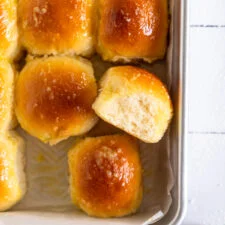
Soft, enriched dinner rolls are baked until golden and brushed with garlic butter while still hot. They make a cosy side for a family meal and can be prepared ahead through the dough-making stages.
Ingredients
- 150 gwhole milk, lukewarm
- 40 gwater, lukewarm
- 1 Tbspgranulated sugar
- 1 tspactive dry yeast
- 1 largeegg, at room temperature
- 245 gbread flour
- 50 gall-purpose flour
- 20 gmilk powder
- 3/4 tspkosher salt
- 45 gunsalted butter, at room temperature
- 1 egg beaten with 1 tsp cold wateregg wash
- 50 gunsalted butter, cold from the fridge is fine
- 2 clovesgarlic, finely minced or grated on a microplane
- Big pinchflaky sea salt such as Maldon
- To finish, to tasteflaky sea salt such as Maldon
Instructions
- 1
Activate the yeast
In the bowl of a stand mixer, combine the milk, water, sugar and yeast. Leave for 5 minutes, until foamy.
- 2
Add the dough ingredients
Add the egg, bread flour, all-purpose flour, milk powder, salt and butter. Mix with the dough hook on low for 2–3 minutes, until combined, scraping down the bowl if dry flour remains out of reach.
- 3
Mix the dough
Raise the mixer speed to medium-high and mix for 15–20 minutes, until the dough is smooth, stretchy and supple, and pulls away from the sides or moves together as one mass. It may look as though it will not come together at first; keep mixing until it develops strength and passes the windowpane test.
- 4
Leave the dough to rise
Turn the dough onto a very lightly floured surface and shape it into a tight ball. Put it in a lightly oiled bowl, cover with plastic wrap and leave in a warm place until doubled in size, about 1½–2½ hours depending on the kitchen temperature.
- 5
Divide the dough
Turn the dough onto a lightly floured surface and divide it into 12 equal-weight pieces. The dough should weigh about 600 g, or roughly 50 g per piece; weigh it and divide the total by 12 to check.
- 6
Shape the rolls
Take one piece at a time, flatten it, tuck the edges up into a ball, then turn it seam-side down. Cup your hand around it and roll against the counter to make a tight ball. Set it aside under a loose cover of plastic wrap, and repeat with the remaining dough, leaving a little space between balls.
- 7
Arrange in the pan
Grease or line a 23 × 33 cm (9 × 13-inch) pan. Leave the dough balls covered for 10 minutes, then briefly re-roll them to tighten their shape and arrange them in the pan with a little space between. Cover with plastic wrap and leave in a warm place for about 1 hour, until puffy; a gentle poke should leave an indentation that slowly springs back.
- 8
Bake the rolls
When about 20 minutes remain in the second rise, heat the oven to 190°C (375°F). Brush the rolls with egg wash and bake uncovered for 15–18 minutes, until evenly golden brown. If checking with a thermometer, the centre should reach 90°C (190°F).
- 9
Finish the rolls
Take the rolls out of the oven. If serving them straight away, brush with garlic butter and sprinkle with extra flaky sea salt.
- 10
Melt the garlic butter
Put the butter and garlic in a small saucepan over medium-low heat. Once the butter has melted, cook for another 1–2 minutes, stirring often, to infuse it and soften the garlic’s sharpness. Add a big pinch of salt and stir to combine. Make it ahead if you like, then re-melt before using.
What are garlic butter dinner rolls?
Dinner rolls are small, soft yeast breads commonly served alongside meals in the United States. This enriched version combines milk, egg and butter in the dough, then gets a savoury garlic-butter finish.
Bread flour helps the dough develop structure, while a little all-purpose flour and milk powder contribute to its tender, soft crumb. Baking the rolls together in a pan keeps them close-set and makes them easy to serve as a batch.
Nutrition and macros by portion
The nutrition label shows one serving as written: 169 calories, 4g protein, 20g carbs, 7g fat.
| Portion | Adjustment | kcal | Protein | Carbs | Fat |
|---|---|---|---|---|---|
| Lighter | Use less garlic butter | 118 kcal | 3g | 14g | 5g |
| This serving | As written | 169 kcal | 4g | 20g | 7g |
| Hungry | Serve extra rolls | 254 kcal | 6g | 30g | 10g |
Most of the carbohydrates come from the two flours, with smaller amounts from the sugar and milk; butter carries much of the fat, while the egg, milk and flour contribute protein. Pair a roll or two with vegetables and a protein-rich main to make a more balanced plate.
Why use two flours?
Bread flour: Its higher gluten-forming potential helps the dough become stretchy enough to hold its shape through a long mix and rise.
All-purpose flour: A smaller amount balances the bread flour in this soft roll dough. Measure both flours carefully so the dough does not become unnecessarily firm.
The long mixing stage
Gluten development: The dough may look messy or slack for a while in the mixer before it gathers strength. Keep it mixing for the full 15–20 minutes, watching for a smooth, elastic dough that moves together.
Windowpane cue: Stretch a small piece gently between your fingers; a thin membrane that does not tear straight away indicates the dough has developed well. If it tears, continue mixing and check again.
Shape evenly
Portion size: Dividing the dough into 12 equal pieces helps the rolls bake at a similar rate. Weigh the full dough and divide that weight by 12 for the most consistent portions.
Surface tension: Tucking the dough underneath and rolling it against the worktop creates a taut outer surface. Keep the balls covered while you shape the rest so they do not dry out.
Read the second rise
Puffy dough: The rolls should look noticeably expanded after about an hour, though the exact time depends on how warm the room is. Use the gentle-poke cue rather than relying on the clock alone.
Slow spring-back: If a light indentation gradually fills in, the rolls are ready for the oven. If it springs back immediately, give them more time; if it stays deeply dented, handle them gently.
Bake to a golden finish
Colour: Brush the rolls with egg wash just before baking for an evenly browned surface. Bake them uncovered at 190°C for 15–18 minutes, until golden.
Garlic butter: Brushing the rolls while they are hot lets the butter coat the tops and run into their soft surfaces. Add the finishing flaky salt just before serving.
Serve with a meal
These rolls pair naturally with soups, stews and roast dinners, where their soft centres are useful for soaking up sauces. They also work alongside salads or a spread of cooked vegetables.
For a more substantial plate, serve them with a protein-rich main and vegetables. Set extra garlic butter on the table for anyone who wants more.
Recipe notes & tips
- Use lukewarm rather than hot milk and water when activating the yeast.
- Scrape the bowl during the initial low-speed mixing if flour is left around the sides.
- Keep the shaped rolls lightly covered so their surfaces do not dry out.
- Start preheating the oven when about 20 minutes remain in the second rise.
- Make the garlic butter ahead and gently re-melt it before brushing it onto the rolls.
Variations
- Herb butter: Stir finely chopped parsley into the finished garlic butter.
- Cheesy tops: Scatter finely grated hard cheese over the egg-washed rolls before baking.
- Extra garlic: Add another clove to the butter if you prefer a stronger garlic flavour.
- Seeded finish: Sprinkle sesame or poppy seeds over the egg wash before baking.
- Plain tops: Leave off the garlic butter and flaky salt for a simple soft dinner roll.
Common mistakes to avoid
- Adding extra flour too soon: The dough can look loose at first, so let the mixer work before adjusting it.
- Cutting the mix short: The rolls may lack strength if the dough is not smooth and stretchy; mix for the stated 15–20 minutes.
- Uneven portions: Rolls of different sizes can finish baking at different times; weigh the dough pieces for consistency.
- Rushing the second rise: Under-proofed rolls will not be as puffy; use the gentle-poke cue before baking.
- Overbaking: The rolls can dry out if left too long; take them out once evenly golden, within the 15–18 minute range.
How to store
Store cooled rolls in an airtight container at room temperature for up to 2 days. Reheat briefly in a low oven until warm; add a little fresh garlic butter if you want to refresh the finish.
Frequently asked questions
Can I make the garlic butter in advance?
Yes. Prepare it ahead, then gently re-melt it before brushing it over the hot rolls.
How do I know when the dough has been mixed enough?
It should look smooth and stretchy, move together as a mass and pass the windowpane test. The full mixing time is 15–20 minutes.
How can I tell when the rolls have risen enough?
They should be puffy, and a gentle poke should leave an indentation that slowly springs back. The rise takes about an hour, but room temperature affects the timing.
Do I need a thermometer to bake the rolls?
No. The recipe treats the internal temperature as an optional check; bake until the rolls are evenly golden brown, usually 15–18 minutes.
Can I serve these rolls without the garlic butter?
Yes. The rolls can be served plain, or you can leave off the finishing butter and flaky salt for a simpler bread roll.
Cook it from the original
This recipe comes from cloudykitchen.com. Their page has the author’s own photos, notes and tips — the best place to cook it from.
Open the recipe on cloudykitchen.com