
Toasted Milk Basbousa with Cream
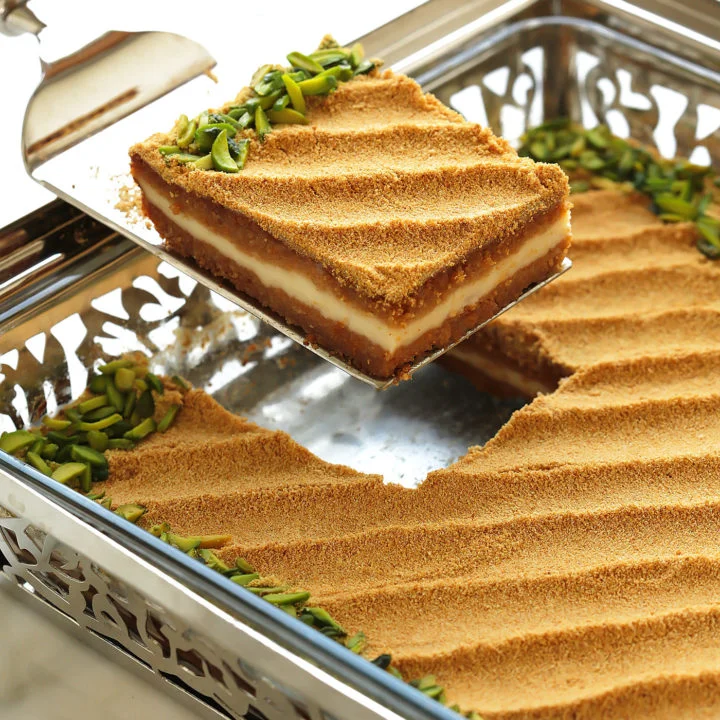
This Middle Eastern basbousa layers semolina cake with a creamy centre, then finishes it with sweetened condensed milk and toasted milk powder. Toasting the milk powder adds deep caramel-like notes, while the cream filling makes each slice soft and rich.
Ingredients
- 180 ml (3/4 cup; about the remainder of a 397 g/14 oz can)sweetened condensed milk, for pouring over the cake
- 50 g (1/2 cup)toasted milk powder, made from powdered milk
- to tastepistachios, optional
- 250 ml (1 cup)whole milk
- 250 ml (1 cup)whipping cream
- 12 g (1 tablespoon)granulated sugar
- 21 g (3 tablespoons)cornflour
- 150 g (1 1/2 cups), dividedpowdered milk
- 166 g (1 cup)medium-grain semolina
- 167 g (3/4 cup)melted ghee, or oil, or half oil and half ghee
- 100 g (1/2 cup)granulated sugar
- 160 g (1 can)cream (eshta/ashta)
- 155 g (1/2 cup)sweetened condensed milk
- 45 ml (3 tablespoons), plus 45 ml (3 tablespoons) for thinning the top battermilk
- 2 teaspoonsbaking powder
- 1/4 teaspoonsalt
Instructions
- 1
Heat the oven
Set a rack in the middle of the oven and preheat it to 180°C (350°F).
- 2
Toast the milk
Put all 150 g of powdered milk in a medium frying pan over a medium heat. Stir constantly for about 10 minutes, until it is a deep golden brown. Keep the heat moderate, as the powder can scorch.
- 3
Reserve the topping
Measure out 50 g (1/2 cup) of the toasted milk powder and set it aside to finish the cake. Keep the remaining 100 g for the batter.
- 4
Coat the semolina
In a large bowl, stir the semolina and melted ghee together until evenly combined. Set aside; the mixture will thicken as it stands.
- 5
Mix the batter base
Put the remaining 100 g toasted milk powder in a medium bowl with the sugar, cream, 155 g sweetened condensed milk, 45 ml milk, baking powder and salt. Whisk until smooth and well combined.
- 6
Combine the mixtures
Pour the toasted milk mixture into the semolina and ghee, then stir with a spatula until combined.
- 7
Layer the base
Weigh out half the batter, about 445 g, and spread it evenly in a lightly greased 33 × 23 cm (13 × 9 inch) baking dish. Set the rest aside.
- 8
Thin the topping
Stir the remaining batter with the extra 45 ml milk until thinner. Transfer it to a piping bag or a food bag with a corner snipped to make an opening about 1 cm wide. Set aside.
- 9
Part-bake the base
Bake the batter in the dish for 10–12 minutes, until it begins to set and is no longer wet. Do not bake it through; it will return to the oven. While it bakes, prepare the filling.
- 10
Whisk the filling
Off the heat, whisk the whole milk, whipping cream, 12 g sugar and cornflour in a medium saucepan until the cornflour has dissolved and no lumps remain.
- 11
Thicken the cream
Set the pan over a medium-high heat and cook, whisking constantly, until large bubbles form across the surface and the mixture reaches a full boil. Cook for about 30 seconds more, until thickened.
- 12
Add the filling
Take the pan off the heat and pour the filling over the part-baked base, spreading it evenly. Chill the dish for about 5 minutes, just until the filling is set enough to support the top layer; it should still be warm.
- 13
Cover with batter
Pipe the thinned batter in lines over the cream until the surface is covered. Carefully smooth it with a spatula or the back of a spoon, covering any exposed cream.
- 14
Bake until set
Return the dish to the oven and bake for 20–25 minutes, until the top is fully set and feels done to the touch.
- 15
Soak with milk
Remove the dish from the oven and immediately pour the remaining 180 ml sweetened condensed milk over the surface. Spread it evenly and leave the cake for about 20 minutes to absorb it; a thin, opaque film will remain.
- 16
Finish and serve
Cool the basbousa to room temperature, then sift the reserved 50 g toasted milk powder over the top. Draw diagonal lines in the powder with a small spoon and add pistachios around the edges if desired. Serve at room temperature or slightly warm.
- 17
Store leftovers
The flavour and texture are best on the day it is made. Keep leftovers tightly covered in the refrigerator for a couple of days, then bring them to room temperature or warm individual portions lightly in the microwave.
What is basbousa?
Basbousa is a Middle Eastern semolina cake, commonly baked until golden and sweetened with syrup or another sweet soak. This version layers a soft semolina base with a cooked cream filling and a second layer of batter.
Toasted milk powder is the distinctive touch: its browned, savoury-sweet flavour brings a caramel-like depth to the cake. The condensed milk soak keeps the layers tender and adds sweetness.
Nutrition and macros by portion
The nutrition label shows one serving as written: 580 calories, 12g protein, 57g carbs, 34g fat.
| Portion | Adjustment | kcal | Protein | Carbs | Fat |
|---|---|---|---|---|---|
| Lighter | Smaller slice, less topping | 406 kcal | 8g | 40g | 24g |
| This serving | As written | 580 kcal | 12g | 57g | 34g |
| Hungry | Larger slice | 870 kcal | 18g | 86g | 51g |
Semolina and the sugars in the condensed milk contribute much of each serving's carbohydrate, while ghee, whipping cream and the canned cream provide much of the fat. Milk powder and cream add some protein. Serve a slice with fresh fruit or alongside a lighter meal to balance the rich dessert.
Why toast the milk powder?
Even browning: Stir the powder constantly over a medium heat for about 10 minutes. Keep it moving and avoid turning up the heat, since dry milk powder can scorch quickly.
Two portions: Set aside 50 g for the finish and use the remaining 100 g in the batter. That gives the topping its toasted aroma while flavouring the cake itself.
Building the layers
Semolina base: Stir the semolina thoroughly with the melted ghee before adding the other mixture. As it sits, it thickens, so spread it into the tin without delay once the batter is combined.
Cream centre: Cook the filling until it has boiled and thickened, then spread it over the base after its first bake. A brief chill helps it support the top layer without letting that batter sink in.
Getting the bake right
First bake: The base needs only 10–12 minutes at 180°C (350°F). Look for a surface that has started to set and is no longer wet, rather than a fully baked cake.
Final bake: After adding the cream and top batter, bake for another 20–25 minutes. The top should feel set to the touch before you add the condensed milk.
The condensed milk finish
Pour the remaining condensed milk over the cake as soon as it comes out of the oven, then spread it across the surface. Give it about 20 minutes to soak in; a thin opaque coating is expected to remain.
Let the cake cool before sifting on the reserved toasted milk powder. The powder stays distinct on the surface, and the diagonal lines give the finish a simple pattern.
Serving and timing
This cake is at its best on the day it is made, once the soak has been absorbed and the cake has cooled. Serve it at room temperature or warm a portion gently.
The rich cream and sweet finish pair well with unsweetened tea or coffee. If serving it as dessert, small slices work well after a lighter meal.
Recipe notes & tips
- Use a light-coloured pan for toasting the milk powder so its colour is easier to judge.
- Measure the toasted milk powder after toasting, setting aside 50 g for the topping.
- Grease the baking dish lightly so the semolina base releases more easily.
- Snip a roughly 1 cm opening in the piping bag to make it easier to cover the cream in lines.
- Keep the filling warm while it waits briefly in the dish so it remains spreadable.
- Allow the condensed milk soak time to settle before adding the toasted powder.
Variations
- Use oil: Replace the ghee with oil, or use half oil and half ghee as in the ingredient options.
- Add pistachios: Scatter them around the edges as a garnish just before serving.
- Skip the garnish: Leave out the optional pistachios for a toasted milk powder finish on its own.
- Serve warm: Warm individual portions gently if you prefer the cream centre slightly warm.
- Make neat slices: Cool the cake fully before cutting so the layered centre has time to set.
Common mistakes to avoid
- Scorching the milk powder: Keep stirring over medium heat and take it off the heat once it is deep golden brown.
- Baking the base through: Remove it after 10–12 minutes when it has just begun to set; it will bake again.
- Lumpy cream filling: Dissolve the cornflour fully into the cold milk and cream before heating.
- Adding the top layer too soon: Chill the cream for about 5 minutes so it can support the batter.
- Leaving gaps in the top: Smooth the piped lines carefully to cover every exposed patch of cream.
- Skipping the soak: Pour the condensed milk over the cake immediately after baking and allow about 20 minutes for it to absorb.
How to store
The cake tastes best on the day it is made. Store leftovers tightly covered in the refrigerator for a couple of days; bring them to room temperature or warm individual portions lightly in the microwave before serving.
Frequently asked questions
Can I use oil instead of ghee?
Yes. The ingredient list allows oil or a mixture of half oil and half ghee in place of the melted ghee.
How can I tell when the milk powder is toasted?
After about 10 minutes of constant stirring over medium heat, it should be a deep golden brown. Do not rush it over high heat, as it can scorch.
Why is the base baked twice?
The first short bake sets the base enough to hold the cream filling. The second bake finishes the top layer and the cake as a whole.
Can I make the cake ahead?
It can be made ahead and kept covered in the refrigerator for a couple of days, though the recipe notes that its taste and texture are best on the day it is made.
Should basbousa be served warm or cold?
Serve it at room temperature or slightly warm. If refrigerated, let it come back towards room temperature or warm individual slices gently.
Cook it from the original
This recipe comes from cleobuttera.com. Their page has the author’s own photos, notes and tips — the best place to cook it from.
Open the recipe on cleobuttera.com