
Sweet and Sour Pork
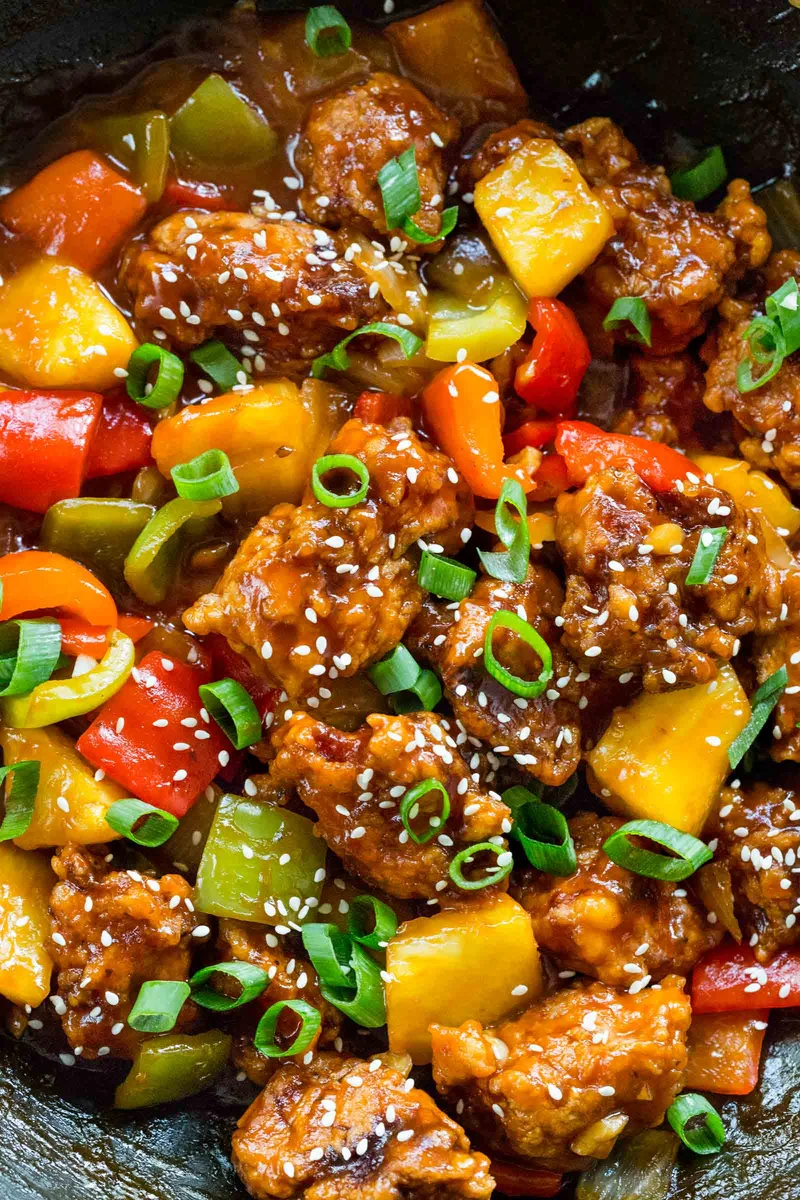
Sweet and sour pork pairs crisp, golden pieces of tenderloin with a glossy honey-vinegar sauce, colourful vegetables and pineapple. It is a good choice when you want a lively stir-fry with a mix of savoury, tangy and sweet flavours.
Ingredients
- 170 g (½ cup)honey
- 90 ml (6 tablespoons)rice vinegar
- 20 ml (4 teaspoons)soy sauce
- 45 ml (3 tablespoons)tomato purée
- 8 g (1 tablespoon)cornflour
- 30 ml (2 tablespoons)water
- 680 g (1½ pounds), cut into 2.5 cm cubespork tenderloin
- 5 g (1 teaspoon), dividedkosher salt
- 1 g (½ teaspoon), dividedblack pepper
- 95 g (¾ cup)plain flour
- 40 g (⅓ cup)cornflour
- 2large eggs
- 475 ml (2 cups), plus 15 ml (1 tablespoon) for fryingvegetable oil
- 1 tablespoonminced garlic
- 150 g (1 cup), chopped into 2 cm pieceswhite onion
- 150 g (1 cup), chopped into 2 cm piecesred pepper
- 150 g (1 cup), chopped into 2 cm piecesgreen pepper
- 165 g (1 cup), cut into 2 cm piecespineapple chunks
- 2 tablespoonssliced spring onion
- ½ teaspoonsesame seeds
Instructions
- 1
Mix the sauce
In a medium bowl, combine the honey, rice vinegar, soy sauce and tomato purée. Set the sauce aside.
- 2
Make the slurry
In a small bowl, stir together the 1 tablespoon of cornflour and 2 tablespoons of water.
- 3
Season the pork
Season the pork with ½ teaspoon of salt and ¼ teaspoon of pepper.
- 4
Mix the coating
Combine the plain flour and ⅓ cup of cornflour in a shallow dish.
- 5
Whisk the eggs
Crack the eggs into a separate shallow dish and whisk them.
- 6
Coat the pork
Coat each pork piece in the flour mixture, dip it in the whisked egg, then coat it once more in the flour mixture.
- 7
Fry the pork
Heat 2 cups of oil in a wok or medium pan over medium-high heat until it reaches 177°C (350°F). Fry the pork in 2 to 3 batches for about 5 to 7 minutes per batch, until golden and cooked through.
- 8
Drain the batches
Transfer the pork to a paper-towel-lined tray to drain, then fry the next batch.
- 9
Clean the wok
Discard the oil and carefully wipe the inside of the wok with paper towels.
- 10
Heat fresh oil
Set the wok over medium-high heat and add 1 tablespoon of oil.
- 11
Cook onion and garlic
When the oil is hot, add the garlic and onion and stir-fry for 30 seconds.
- 12
Add the peppers
Add the red and green peppers and stir-fry for 1 minute.
- 13
Add pineapple
Add the pineapple and stir-fry for 1 minute.
- 14
Combine with sauce
Return the pork to the wok and add the sweet and sour sauce. Stir to combine and bring the sauce to a boil.
- 15
Thicken the sauce
Stir the cornflour slurry, then pour it into the pan while stirring constantly. Cook for 60 seconds, until the sauce thickens, and toss everything to coat the pork.
- 16
Garnish and serve
Scatter over the spring onion and sesame seeds, then serve over rice.
What is sweet and sour pork?
Sweet and sour pork is a Chinese-style dish built around crisp pork and a sauce that balances sweetness with vinegar tang. Versions vary, but the combination of pork, peppers and pineapple is familiar in many restaurant-style preparations.
Here, tenderloin is coated and fried before being tossed with a honey-based sauce. Cooking the vegetables briefly keeps their colour and gives the dish a contrast of crisp edges, juicy fruit and glossy sauce.
Nutrition and macros by portion
The nutrition label shows one serving as written: 480 calories, 29g protein, 61g carbs, 14g fat.
| Portion | Adjustment | kcal | Protein | Carbs | Fat |
|---|---|---|---|---|---|
| Lighter | Use less frying oil | 336 kcal | 20g | 43g | 10g |
| This serving | As written | 480 kcal | 29g | 61g | 14g |
| Hungry | Add a larger rice portion | 720 kcal | 44g | 92g | 21g |
The pork supplies most of the protein, while the flour, cornflour, honey and pineapple contribute carbohydrates. Frying oil and the egg-based coating account for much of the fat. Serve with a moderate portion of rice and add steamed greens to balance the plate with extra vegetables.
Build the sweet and sour sauce
Sauce base: honey provides sweetness, rice vinegar brings acidity, and soy sauce adds savoury depth. Tomato purée rounds out the colour and flavour.
Slurry: mix the cornflour with water before it goes into the hot wok. Stir it again just before adding, as the starch can settle at the bottom.
Get a crisp coating
Three-stage coating: flour and cornflour first, egg next, then another layer of the flour mixture. Coat the pieces individually so the batter reaches their sides.
Hot oil: aim for 177°C before frying, and cook the pork in 2 to 3 batches. Crowding the pan can lower the oil temperature and make the coating less crisp.
Check the pork and vegetables
Pork: fry for about 5 to 7 minutes, looking for a golden coating and pork cooked through. The recipe does not specify a separate internal-temperature target.
Vegetables: the onion and garlic need just 30 seconds, followed by 1 minute for the peppers and 1 minute for the pineapple. This short stir-fry leaves some bite in the vegetables.
Finish the sauce in the wok
Boil first: add the sauce with the pork and let it come to a boil before adding the slurry. Stir the slurry, then keep the mixture moving as it cooks for 60 seconds.
Coat evenly: once the sauce thickens, toss the ingredients so it covers the pork and vegetables. Serve promptly, while the fried coating is at its crispest.
What to serve alongside it
Rice: serve the pork over rice as directed, which makes a simple base for the sweet and sour sauce. Plain steamed rice lets the sauce remain the main flavour.
For a meal with more vegetables, add a simple side of steamed greens. Keep any extra sides lightly seasoned so they do not compete with the sauce.
Recipe notes & tips
- Cut the pork into similarly sized cubes so the pieces cook at a similar rate.
- Have the sauce, slurry and chopped vegetables ready before frying the pork.
- Fry in batches rather than filling the wok with pork all at once.
- Drain each batch on paper towels while you finish cooking the remaining pieces.
- Stir the cornflour slurry just before adding it to the wok.
- Serve as soon as the sauce has thickened to help preserve the pork's crisp coating.
Variations
- Use chicken: Cut boneless chicken into cubes and follow the same coating and frying method.
- Add more vegetables: Include extra peppers or onion while keeping the stir-fry times brief.
- Try a different fruit: Swap some of the pineapple for chunks of peach.
- Adjust the tang: Add a little more rice vinegar to the sauce if you prefer a sharper flavour.
- Make it less sweet: Reduce the honey and taste the sauce before adding it to the wok.
Common mistakes to avoid
- Crowding the wok: The oil can cool and the coating may turn soft; fry in 2 to 3 batches.
- Adding slurry without stirring: Cornflour may have settled; stir the mixture immediately before pouring it in.
- Frying before the oil is hot: The coating can absorb more oil; wait until it reaches 177°C.
- Overcooking the vegetables: They can lose their bite; stick to the short stir-fry times in the method.
- Leaving the coated pork to sit: The coating may become damp; fry it after breading and work in batches.
How to store
Refrigerate leftovers in a covered container for up to 3 days. Reheat in a pan until piping hot; the pork coating may soften after storage.
Frequently asked questions
Can I prepare the sauce ahead?
Yes. Mix the honey, rice vinegar, soy sauce and tomato purée in advance and refrigerate it in a covered container. Make and stir the cornflour slurry just before using it.
How can I tell when the pork is cooked?
The recipe gives a frying time of about 5 to 7 minutes per batch and says to cook until the pork is cooked through. Keep the pieces evenly sized for more consistent cooking.
Can I make this without a wok?
Yes. The method also works in a medium-sized pan. Choose one with enough room to fry the pork in batches and stir-fry the remaining ingredients.
Why is the pork fried in batches?
Batches help keep the oil hot and give the pieces room to brown. If the pan is crowded, the pork is more likely to steam than fry evenly.
Can I use tinned pineapple?
Yes. Drain it well and cut the chunks to roughly the same size as the recipe calls for before adding them to the wok.
What should I serve with sweet and sour pork?
Serve it over rice, as the method suggests. Steamed greens also make a straightforward side.
Cook it from the original
This recipe comes from cafedelites.com. Their page has the author’s own photos, notes and tips — the best place to cook it from.
Open the recipe on cafedelites.com