
Coca de Sant Joan
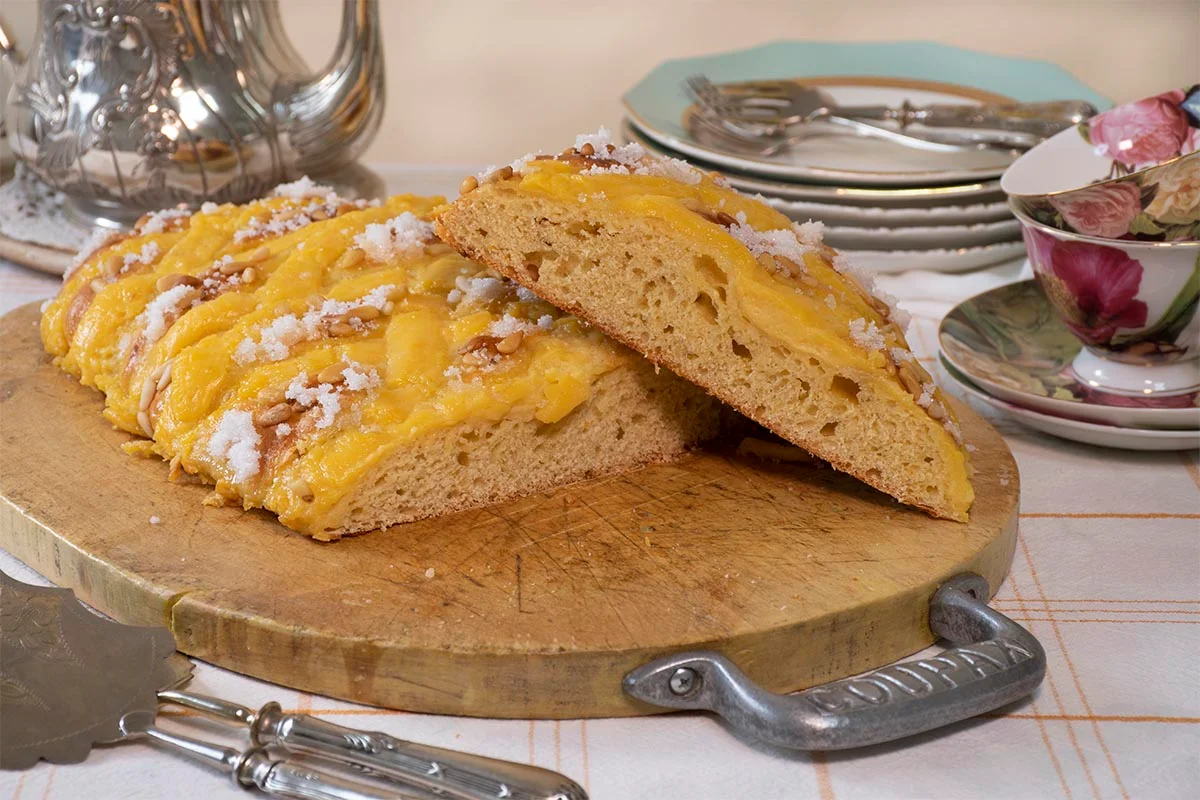
Coca de Sant Joan is a soft, enriched Catalan sweet bread topped with pastry cream, pine nuts and dampened sugar. It makes a celebratory centrepiece for the midsummer table, with a tender crumb that is best enjoyed once cooled.
Ingredients
- 400 gstrong white bread flour
- 100 mlmilk, at room temperature
- 2 largeeggs, lightly beaten
- 125 gsugar
- 80 gbutter, cubed
- to tasteorange zest (or lemon zest, or anise essence)
- a pinchsalt
- 150 g sourdough starter, very active, plus 1 g fresh baker’s yeastsourdough starter and fresh baker’s yeast
- 15 g fresh baker’s yeast or 5 g dried baker’s yeastbaker’s yeast
- 1egg, beaten
- to tastesugar, dampened
- 20 gpine nuts
- to tastetraditional pastry cream
Instructions
- 1
Mix and knead
Put the flour in a bowl and add the sugar, lightly beaten eggs, milk, yeast (or the sourdough starter and 1 g yeast), orange zest and cubed butter. Mix until combined, then turn the dough out on to the work surface and knead for 10 minutes, or until smooth and glossy. Shape into a ball, place in an oiled bowl, cover and leave to rise until doubled in size.
- 2
Make the cream
While the dough rises, make the pastry cream and transfer it to a piping bag. Leave it to cool.
- 3
Shape and prove
Turn the dough out on to baking paper and press out the air. Shape it into a rectangle, fold one half towards the centre, then fold it over itself again. Cover with a cloth and leave to prove for about 1 hour, away from draughts.
- 4
Heat the oven
Preheat the oven to 180°C, with heat from above and below.
- 5
Add the toppings
Brush the coca with beaten egg. Pipe the pastry cream in lines to form diamond shapes, then scatter over the pine nuts and dampened sugar.
- 6
Bake the coca
Bake for 35 minutes, or until lightly golden. For a more precise doneness check, insert a kitchen thermometer into the centre of the dough; it is ready when it reaches 96°C.
- 7
Cool and serve
Once baked, transfer the coca to a wire rack. Leave it to cool before serving.
What is coca de Sant Joan?
Coca de Sant Joan is a festive Catalan sweet bread traditionally associated with the celebrations around the summer solstice and the feast of Saint John. It is an enriched, yeasted dough, often finished with pastry cream and crunchy toppings.
This version gets its soft, fluffy crumb from milk, eggs and butter, while the cream piped into diamonds, pine nuts and dampened sugar give it a festive finish.
Nutrition and macros by portion
The nutrition label shows one serving as written: 430 calories, 11g protein, 66g carbs, 14g fat.
| Portion | Adjustment | kcal | Protein | Carbs | Fat |
|---|---|---|---|---|---|
| Lighter | Smaller slice, fewer toppings | 301 kcal | 8g | 46g | 10g |
| This serving | As written | 430 kcal | 11g | 66g | 14g |
| Hungry | Larger slice | 645 kcal | 17g | 99g | 21g |
The flour and sugar provide most of the carbohydrates, while butter and eggs contribute much of the fat; the eggs, milk, flour and pastry cream also provide some protein. Serve a slice with fresh fruit, or alongside a less sweet drink, to balance the rich bread and toppings.
Choosing the dough ingredients
Strong flour: its higher protein content helps the dough hold its shape and gives the finished coca a springy, stretchy crumb.
Yeast and starter: follow one of the stated options, rather than combining the full quantities of both. The recipe also gives a starter option with an extra 1 g of fresh yeast.
Citrus: orange zest is the suggested flavour, but lemon zest or anise essence can be used instead.
Kneading and the first rise
Kneading: work the dough for about 10 minutes, until it feels smooth and looks glossy. It will be enriched and soft, so give it time to come together rather than adding extra flour.
First rise: use the doubled volume as your cue, since the time needed can vary with room temperature and yeast activity. Keep the covered bowl away from draughts while it ferments.
Shaping the rectangle
Folding: press the risen dough to release the air, shape it into a rectangle and fold it in half towards the centre, then over itself again. This creates the layered shape described in the method.
Second prove: let the shaped dough rest, covered, for about 1 hour. It should have time to relax before the toppings go on.
Piping the pastry cream
Cool cream: make the pastry cream while the dough rises, then leave it to cool before filling the piping bag. This helps it hold its shape when piped.
Diamond pattern: pipe lines across the surface so they meet in a diamond pattern. Scatter over the pine nuts and dampened sugar after brushing with beaten egg.
Checking when it is baked
Colour: bake at 180°C for 35 minutes, looking for a lightly golden surface. The dough should be baked through rather than judged by colour alone.
Centre temperature: the recipe gives 96°C as the target reading at the centre of the dough. Insert the thermometer into the bread, avoiding a thick line of pastry cream if possible.
Serving the coca
Cooling: transfer the baked coca to a wire rack and let it cool before slicing. This gives the crumb time to settle and makes the cream-topped slices easier to serve.
On the table: serve it as a sweet finish to a meal or alongside coffee. Cut into 10 portions, using the diamond pattern as a guide.
Recipe notes & tips
- Have the butter cubed and the eggs lightly beaten before you start mixing.
- Oil the bowl lightly so the dough can be removed easily after its first rise.
- Use baking paper beneath the dough to make shaping and transferring simpler.
- Pipe the pastry cream in steady lines to create an even diamond pattern.
- Check the centre with a kitchen thermometer if you want a doneness cue beyond the surface colour.
- Cool the coca on a wire rack before cutting so the crumb can settle.
Variations
- Lemon zest: use lemon instead of orange for a brighter citrus note.
- Anise: flavour the dough with anise essence instead of citrus zest.
- Sourdough option: use the stated active starter with 1 g fresh yeast in place of the alternative yeast quantity.
- Dried yeast: use 5 g dried baker’s yeast instead of 15 g fresh baker’s yeast.
- Cream pattern: pipe the pastry cream in a regular diamond grid across the dough.
Common mistakes to avoid
- Adding both yeast options: choose the listed fresh or dried yeast amount, or use the starter option with its additional 1 g fresh yeast.
- Stopping kneading early: continue until the dough is smooth and glossy, which the method estimates takes about 10 minutes.
- Rushing the first rise: wait until the dough has doubled in volume rather than relying only on a set time.
- Using warm pastry cream: let it cool before piping so it is easier to arrange on the coca.
- Skipping the second prove: cover the shaped dough and give it about 1 hour away from draughts.
- Baking by colour alone: check the centre with a thermometer and look for the stated 96°C reading.
How to store
Once completely cool, keep the coca covered in the refrigerator because it is topped with pastry cream, and eat within 2 days. Bring slices towards room temperature before serving; the recipe does not specify a reheating method.
Frequently asked questions
Can I use sourdough starter instead of baker’s yeast?
Yes. The ingredient list gives 150 g of very active starter with an additional 1 g of fresh baker’s yeast as an option. The method contrasts this with the separate yeast quantity, so use one option rather than both full amounts.
Can I use dried yeast?
Yes. The listed alternative is 5 g dried baker’s yeast in place of 15 g fresh baker’s yeast.
How long should the dough rise?
For the first rise, wait until it has doubled in volume. After shaping, the recipe calls for about 1 hour of proving, though the time can vary with conditions.
Can I prepare the pastry cream ahead?
The method makes the cream while the dough rises and says to leave it to cool in a piping bag. It does not give a separate make-ahead schedule.
How do I know the coca is done?
The recipe says to bake for 35 minutes, until lightly golden, or until the centre of the dough reaches 96°C on a kitchen thermometer.
Can I make it without pine nuts?
You can leave them off if needed, though they are one of the listed toppings. The dampened sugar and pastry cream can still be used as directed.
Cook it from the original
This recipe comes from lacocinadefrabisa.lavozdegalicia.es. Their page has the author’s own photos, notes and tips — the best place to cook it from.
Open the recipe on lacocinadefrabisa.lavozdegalicia.es