
A Guarda egg-yolk ring cake
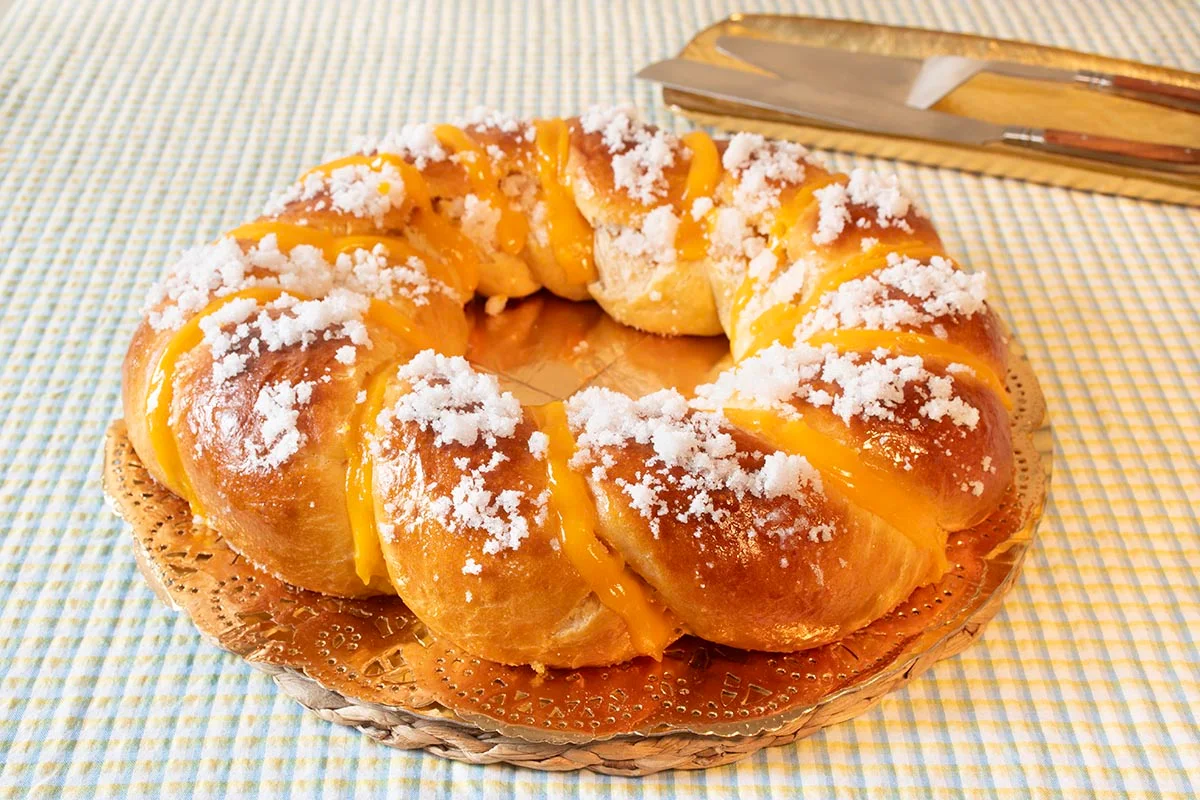
This Galician ring cake is a soft, braided enriched dough filled with egg-yolk cream and finished with syrup and crunchy dampened sugar. It takes a few stages, but the make-ahead cream and tender crumb make it a special bake for sharing.
Ingredients
- 150 mlmilk
- 25 gflour
- All of ittangzhong
- 20 g fresh (or 8 g dried)baker’s yeast
- 3 largeeggs
- 50 mlanise liqueur (or milk)
- 50 mlmilk
- 110 gsugar
- 100 gbutter (or cooked beef-milk butter)
- 500 ghigh-protein flour, such as Manitoba or strong bread flour
- 7egg yolks
- 50 gwater
- 120 gsugar
- 150 mlwater
- 150 gsugar
- To tastesugar, moistened
- 1egg, beaten
Instructions
- 1
Cook the tangzhong
Whisk the 25 g of flour with the 150 ml of milk in a pan or small saucepan over low heat, around 65°C, stirring continuously until it forms a thick paste. Cover with cling film and leave to cool to room temperature.
- 2
Make the syrup
Put the 50 g of water and 120 g of sugar in a saucepan and bring to the boil until the sugar has dissolved. Take it off the heat and set aside.
- 3
Cook the yolk cream
Whisk the yolks in a bowl to break them up. Slowly pour in the hot syrup while whisking, then return the mixture to the saucepan. Cook over medium heat, stirring constantly, until thickened. Transfer to a piping bag or a bowl covered with cling film touching the surface, then refrigerate until needed.
- 4
Make the glaze
Put the 150 ml of water and 150 g of sugar in a saucepan. Boil for a few minutes until syrupy, then leave to cool.
- 5
Mix the dough
Put the flour, all the tangzhong, yeast, 110 g of sugar, lightly beaten eggs, 50 ml of milk, a pinch of salt and the anise liqueur in a stand-mixer bowl. Knead with the mixer’s mixing attachment at medium-low speed for about 10 minutes, until smooth and combined. Leave the dough to rest for 10 minutes.
- 6
Knead in butter
Switch to the dough hook and increase the mixer to high speed. Add the butter in small pieces, a little at a time, allowing each addition to be absorbed before adding more. Knead until the dough pulls away from the sides of the bowl and looks smooth and shiny.
- 7
Let dough rise
Turn the dough onto a lightly floured work surface, shape it into a ball and place it in a large oiled bowl. Cover and leave to rise until doubled in size. For an overnight rise, refrigerate it at this stage; use 12 g of fresh yeast instead of 20 g, then let the dough stand at room temperature for 1–1½ hours the next day before continuing.
- 8
Fill the strands
Turn out the risen dough, press out the gas and divide it into two equal pieces. Shape each into a cord about 75 cm long, then roll each one flat along its length. Pipe a thin line of yolk cream down each piece, fold the dough around the filling and seal the edges well.
- 9
Braid and prove
Braid the two filled cords and join the braid into a ring, pressing the ends together to seal. Transfer it to a baking tray lined with baking parchment, brush with beaten egg, cover loosely with cling film and leave to rise until nearly doubled, about 40–60 minutes.
- 10
Bake the ring
Brush the risen ring with beaten egg again. Bake in a preheated oven at 180°C, using heat from above and below, for about 35–40 minutes, or until the centre reaches about 95°C on a probe thermometer.
- 11
Glaze and finish
Five to 10 minutes before baking is finished, brush the ring with the cooled glaze and sprinkle with moistened sugar. Return it to the oven for a few minutes so the sugar dries. When baking is complete, leave the oven door open for 10 minutes, then transfer the ring to a rack. Pipe any remaining yolk cream into the joins, leave to cool and serve.
What is an A Guarda egg-yolk ring cake?
This Galician bake is a ring-shaped enriched bread, braided around a filling of sweet egg-yolk cream. It brings together the soft, yeasted texture of a celebration loaf with the glossy finish of a syrup-glazed cake.
Tangzhong helps the dough hold on to moisture, while the braid keeps the filling tucked inside and gives each slice a layered look.
Nutrition and macros by portion
The nutrition label shows one serving as written: 421 calories, 10g protein, 67g carbs, 12g fat.
| Portion | Adjustment | kcal | Protein | Carbs | Fat |
|---|---|---|---|---|---|
| Lighter | Smaller cake slice | 295 kcal | 7g | 47g | 8g |
| This serving | As written | 421 kcal | 10g | 67g | 12g |
| Hungry | Larger cake slice | 632 kcal | 15g | 101g | 18g |
Most of the carbohydrates come from the flour and sugar, while the butter and egg yolks contribute much of the fat. Eggs, yolks, milk and flour provide some protein. Balance a slice with fresh fruit or plain yoghurt, and serve it after a meal rather than alongside other sweet dishes.
The dough’s key ingredients
Strong flour: high-protein flour gives the dough enough structure to stretch into long filled cords without tearing.
Anise liqueur: it lends a distinctive aromatic note; the recipe allows the same quantity of milk instead if you prefer to leave it out.
Butter: adding it gradually after the first kneading helps the dough absorb the fat and become smooth and elastic.
Why make tangzhong?
Tangzhong: this cooked flour-and-milk paste is the dough’s first preparation. Stir it over low heat until thick, then cool it before mixing it with the yeast and other dough ingredients.
Temperature: the method specifies about 65°C for cooking the paste. Keep stirring so it thickens evenly, and do not add it to the dough while hot.
Filling and sealing the braid
Yolk cream: chill it before piping so it is easier to handle. Apply a narrow line down each flattened strip rather than spreading it close to the edges.
Seams: fold the dough around the filling and pinch the edges closed carefully. A good seal helps keep the cream inside as you braid and shape the ring.
How to judge the rise and bake
First rise: wait for the dough to double in size; the time will depend on how warm the room is. If chilling overnight, reduce the fresh yeast to 12 g as directed.
Second rise: allow 40–60 minutes, looking for a braid that has expanded until nearly twice its original size. Bake at 180°C for 35–40 minutes, checking for about 95°C at the centre if you have a probe thermometer.
A glossy, sugared finish
Syrup: brush it on during the final 5–10 minutes of baking, then scatter over the moistened sugar. Returning the ring to the oven briefly helps dry the sugar.
Cooling: leave the cake in the switched-off oven with the door open for 10 minutes, then move it to a rack. Pipe the remaining yolk cream into the joins once it is out of the oven.
What to serve with it
Serve slices on their own with coffee or tea, as the filling and glaze make the cake rich and sweet. Fresh fruit or plain yoghurt can add a refreshing contrast alongside it.
For a celebratory table, cut the ring into wedges just before serving so the braided layers and cream are visible.
Recipe notes & tips
- Cool the tangzhong fully before mixing it into the dough.
- Add the butter gradually so the dough has time to absorb it.
- Use a light dusting of flour on the work surface to keep the dough manageable without drying it out.
- Seal the filled cords firmly before braiding to reduce leaks.
- Check the cake near the end of baking, as oven timings can vary.
- Brush on the glaze and add the sugar only during the final minutes of baking.
Variations
- Use milk: replace the 50 ml of anise liqueur with the same quantity of milk for a milder flavour.
- Use cooked butter: substitute cooked beef-milk butter for the regular butter as suggested in the recipe.
- Try dried yeast: use 8 g of dried baker’s yeast in place of 20 g fresh yeast.
- Make it overnight: refrigerate the first rise and reduce the fresh yeast to 12 g.
- Add a citrus note: flavour the yolk cream with finely grated lemon zest.
Common mistakes to avoid
- Hot tangzhong: it can interfere with the dough; let it cool to room temperature first.
- Butter added all at once: the dough may struggle to absorb it; add small pieces gradually.
- Loose filling seams: cream can escape during shaping; pinch the edges closed before braiding.
- Underproofed ring: it may bake up dense; wait until the second rise has nearly doubled the ring.
- Glaze added too early: it can darken during the long bake; brush it on only in the final 5–10 minutes.
- Cutting while hot: the filling and crumb are harder to portion neatly; let the cake cool before slicing.
How to store
Once cool, store the ring in an airtight container at room temperature and eat within 2 days. Warm slices briefly in a low oven, or freeze individual portions well wrapped for up to 2 months and thaw before serving.
Frequently asked questions
Can I make the dough the day before?
Yes. Refrigerate it after the first rise, using 12 g of fresh yeast instead of 20 g. The next day, leave it at room temperature for 1–1½ hours before shaping.
Can I use milk instead of anise liqueur?
Yes. The recipe gives 50 ml of milk as a direct substitute for the 50 ml of anise liqueur.
Can I use dried yeast?
Yes. Use 8 g of dried baker’s yeast instead of 20 g fresh yeast.
How can I tell when the cake is baked?
Bake for about 35–40 minutes at 180°C. The method gives a centre temperature of about 95°C as an additional check.
When should I add the syrup and sugar?
Brush on the glaze 5–10 minutes before the end of baking, sprinkle with moistened sugar, then return the cake to the oven briefly to dry the sugar.
Can I prepare the yolk cream ahead?
Yes. Cover it with cling film touching the surface and refrigerate it until you are ready to fill the dough.
Cook it from the original
This recipe comes from lacocinadefrabisa.lavozdegalicia.es. Their page has the author’s own photos, notes and tips — the best place to cook it from.
Open the recipe on lacocinadefrabisa.lavozdegalicia.es