
Viennese bread
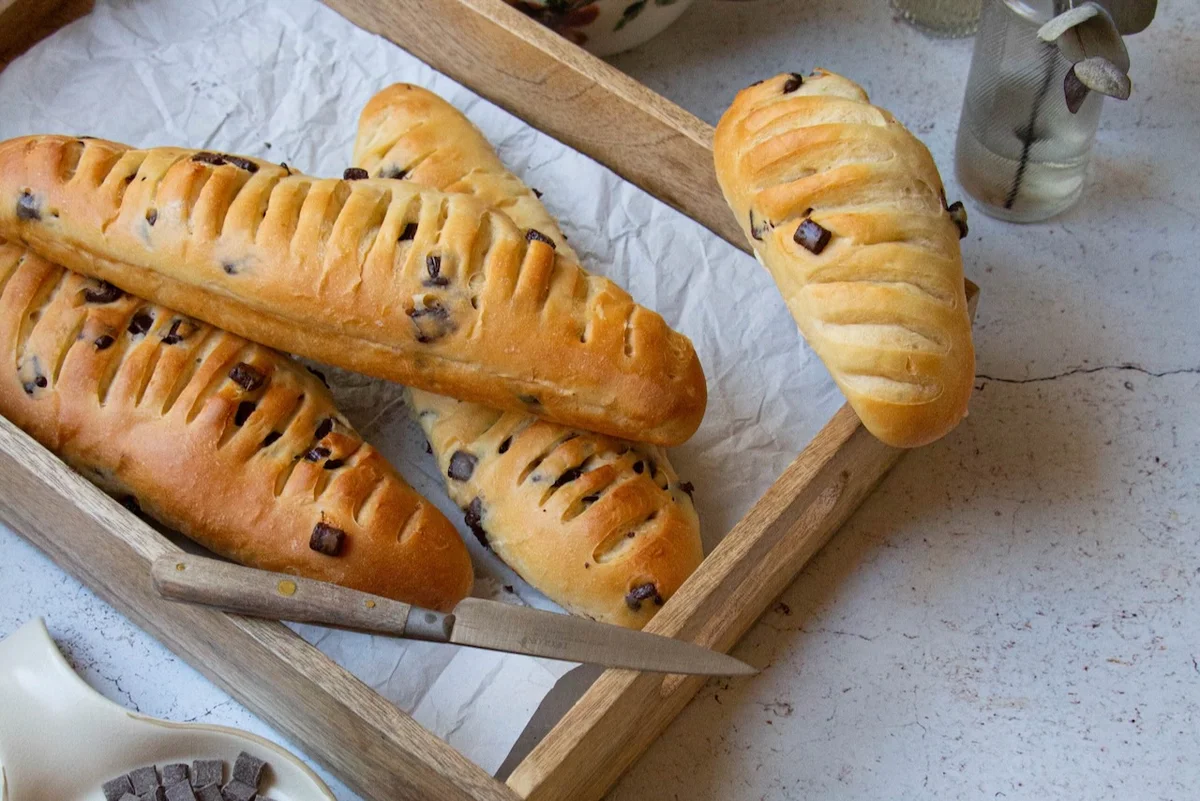
Viennese bread is a soft, lightly enriched loaf somewhere between everyday bread and brioche, with chocolate chips folded through the dough. These individually shaped rolls make a lovely breakfast or afternoon treat, and can also be made plain.
Ingredients
- 400 gT55 flour (or T45 flour)
- 30 gsugar
- 8 g (2 teaspoons)salt
- 200 gmilk
- 40 gwater
- 15 g (or 3 g dried baker’s yeast)dried sourdough starter
- 7 g (or 14 g fresh baker’s yeast)dried baker’s yeast
- 60 gsoft butter
- 1egg
- 150 gchocolate chips
Instructions
- 1
Combine ingredients
Put the flour, sugar and salt in one side of a stand mixer bowl, and the sourdough starter and yeast on the other side. Add the milk, then gradually pour in the water while kneading at low speed (2 out of 6).
- 2
Knead the dough
Knead at low speed for 5 minutes, then increase the mixer to speed 4 out of 6 and knead for a further 5 minutes.
- 3
Add the butter
Add the soft butter in pieces and continue kneading at the higher speed for 5 minutes.
- 4
Mix in chocolate
The dough should pull away from the sides of the bowl. Add the chocolate chips and mix briefly at low speed, just until they are distributed.
- 5
Leave to rise
Shape the dough into a ball and cover it with a damp cloth. Leave it to rise for 1 hour, in a warm, humid place if possible.
- 6
Divide the dough
Dust the work surface with flour and divide the dough into 4 equal pieces. Shape them into balls and cover with the cloth.
- 7
Rest and flatten
After 15 minutes, flatten each ball. Fold one third towards the middle, then fold the other third over it.
- 8
Fold lengthways
Fold each piece in half lengthways and press the edge lightly to seal it.
- 9
Shape the rolls
Roll each piece into a loaf about 15 cm long.
- 10
Brush with egg
Set the loaves seam-side down on baking parchment and brush them with the beaten egg.
- 11
Chill and rebrush
Refrigerate the loaves for 10 minutes, then brush them with egg again.
- 12
Score and prove
Make crosswise cuts in the tops, then leave the loaves to rise for 1 hour 30 minutes.
- 13
Heat the oven
Preheat the oven to 160°C, placing a baking tray on a low shelf.
- 14
Add steam and bake
When the oven is hot, pour 50 ml of water onto the tray on the lower shelf and put the loaves on the middle shelf.
- 15
Bake and cool
Bake for about 15 minutes, until the loaves are golden. Transfer them to a wire rack to cool.
What is Viennese bread?
Despite its name, Viennese bread is a French bakery-style loaf: soft and enriched, but less rich than a classic brioche. Its name is associated with the Viennese baking influence that helped shape French bread-making in the nineteenth century.
This version uses milk, butter and chocolate chips for a tender crumb and a sweet finish. Individual loaves are easy to portion and suit breakfast or an afternoon snack.
Nutrition and macros by portion
The nutrition label shows one serving as written: 660 calories, 17g protein, 99g carbs, 21g fat.
| Portion | Adjustment | kcal | Protein | Carbs | Fat |
|---|---|---|---|---|---|
| Lighter | Use fewer chocolate chips | 462 kcal | 12g | 69g | 15g |
| This serving | As written | 660 kcal | 17g | 99g | 21g |
| Hungry | Serve with yoghurt and fruit | 990 kcal | 26g | 149g | 32g |
The flour supplies most of the carbohydrates, while the butter and chocolate chips contribute much of the fat; the milk, egg and flour add some protein. Pair a loaf with fruit and plain yoghurt for a plate with more freshness and protein.
The flour and leavening
Flour choice: T55 is the specified flour, with T45 offered as an alternative. Either gives the dough its structure; weigh it carefully so the dough is not made overly firm with extra flour.
Leavening: The recipe lists dried sourdough starter and baker’s yeast, with alternatives in parentheses. Keep the quantities and substitutions as listed, and avoid letting the salt sit directly against the leavening before mixing.
Building a soft dough
Gradual mixing: Add the water little by little while the mixer runs slowly. This gives the flour time to take up the liquid before the dough is kneaded more vigorously.
Butter stage: Add the soft butter only after the first two kneading stages. The dough should become smooth and pull away from the bowl before the chocolate chips go in.
Shaping the loaves
Rest: The 15-minute pause after dividing the dough gives it a chance to relax, making the pieces easier to flatten and fold.
Seal: Fold the dough lengthways and press the edge closed before rolling each piece into a 15 cm loaf. Place it seam-side down so it stays closed as it rises.
Proving and scoring
Second rise: After shaping, allow the loaves to rise for the full 1 hour 30 minutes. They should look noticeably puffed before baking; the exact pace can vary with the warmth of the room.
Cuts: Make the crosswise scores after the second egg wash and just before the final rise. Use a sharp blade and keep the cuts light rather than pressing the dough flat.
Steam and bake
Steam: Pouring 50 ml of water onto the hot lower tray creates steam in the oven. Take care when doing this, as the water and escaping steam can cause burns.
Colour: Bake at 160°C for about 15 minutes, watching for a golden surface. Transfer the loaves to a wire rack when done so their bases do not become damp as they cool.
How to serve them
Serve the loaves warm or at room temperature for breakfast or an afternoon snack. They are satisfying on their own, or alongside fruit and yoghurt for a more rounded plate.
For a plain version, leave out the chocolate chips and follow the same method. The lightly sweet, buttery dough still makes a soft loaf.
Recipe notes & tips
- Bring the butter to room temperature so it incorporates smoothly.
- Add the water gradually rather than pouring it in all at once.
- Keep the chocolate-chip mixing brief so the dough is not overworked.
- Use baking parchment to move the shaped loaves without stretching them.
- Pour the water onto the lower tray carefully, keeping your face and hands away from the steam.
- Cool the loaves on a wire rack to prevent soggy bases.
Variations
- Plain loaves: Leave out the chocolate chips and shape the dough as directed.
- Dark chocolate: Use dark chocolate chips for a less sweet, more cocoa-forward loaf.
- Milk chocolate: Choose milk chocolate chips for a sweeter, creamier bite.
- Smaller rolls: Divide the dough into more pieces and keep an eye on them, as smaller loaves may bake sooner.
- Breakfast pairing: Serve a loaf with fresh fruit and yoghurt for a simple breakfast.
Common mistakes to avoid
- Adding all the water at once: Pour it in gradually while the mixer runs so the dough can absorb it evenly.
- Adding butter too early: Wait until the initial kneading stages are complete, as the recipe directs.
- Overmixing the chocolate: Mix for only a few seconds at low speed to keep the chips distributed through the dough.
- Skipping the rests: Keep the 15-minute rest and the full final rise so the shaped loaves can relax and puff up.
- Placing loaves seam-side up: Set them seam-side down on the parchment to help keep the seal underneath.
- Rushing the cooling: Move baked loaves to a wire rack so steam can escape from underneath.
How to store
Once completely cool, keep the loaves in an airtight container at room temperature and eat within 2 days for the softest texture. Rewarm briefly in a low oven, or freeze well-wrapped loaves and defrost before serving.
Frequently asked questions
Can I make these loaves without chocolate?
Yes. Leave out the chocolate chips and follow the same mixing, shaping and baking method.
Can I use T45 flour instead of T55?
Yes. T45 is given as an alternative in the recipe, and the quantity remains 400 g.
How can I tell when the dough has been kneaded enough?
After the butter has been incorporated, the dough should pull away from the sides of the mixer bowl.
How long does the dough need to rise?
The first rise is 1 hour, followed by a 15-minute rest after dividing and a final rise of 1 hour 30 minutes after shaping and scoring.
Why add water to a tray in the oven?
The 50 ml of water poured onto the hot lower tray creates steam during baking. Pour it carefully to avoid the hot steam.
Can I freeze the baked loaves?
Yes. Let them cool completely, wrap them well and freeze. Defrost before serving, then warm briefly if you like.
Cook it from the original
This recipe comes from casseroleetchocolat.fr. Their page has the author’s own photos, notes and tips — the best place to cook it from.
Open the recipe on casseroleetchocolat.fr