
Apple Danish Recipe
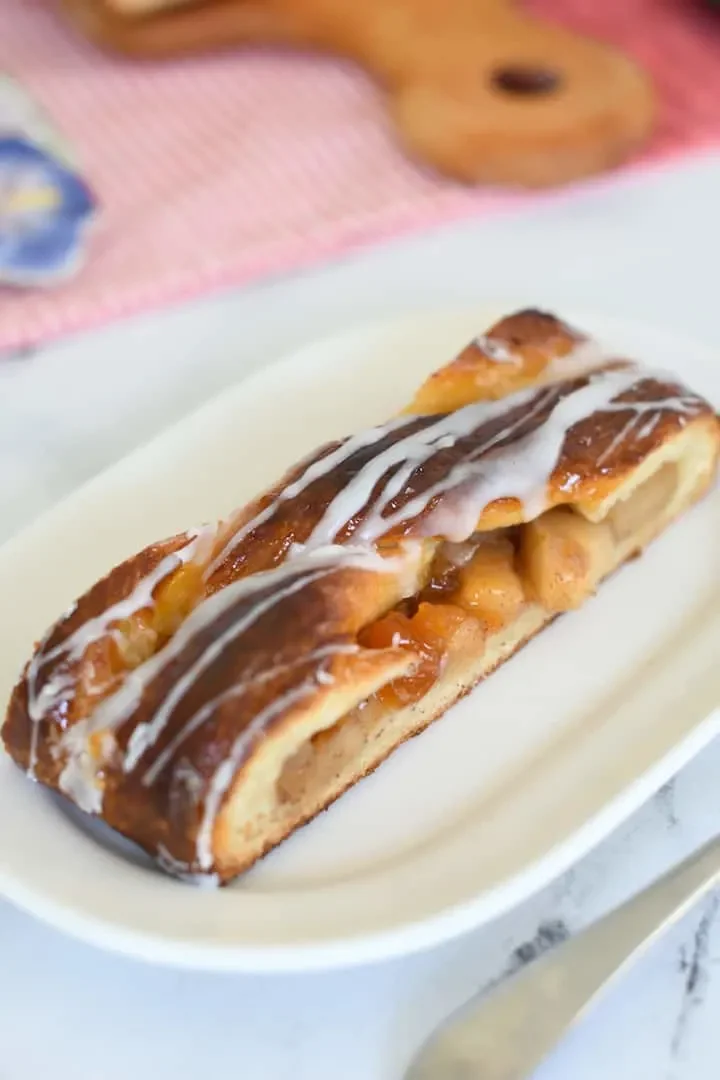
This Apple Danish is a braided pastry filled with cinnamon-scented apples and finished with apple jelly and a simple sugar glaze. Make the filling ahead, then shape the Danish for a warm breakfast or a sweet afternoon treat.
Ingredients
- 680 g (1 1/2 lb)apples, peeled, cored and cut into 1.3 cm (1/2 in) cubes
- 57 g (2 oz; 1/4 cup)brown sugar
- 118 ml (4 oz; 1/2 cup)apple cider or apple juice
- 1/8 teaspoonsalt
- 1/2 teaspoonground cinnamon
- 1/2 teaspoonvanilla extract
- 1 tablespooncornflour
- 1 recipeDanish dough or sourdough Danish dough
- 1 largeegg, for egg wash
- 60 ml (1/4 cup)apple jelly or apricot preserves
- 2–3 teaspoonsmilk
- 57 g (2 oz; 1/2 cup)icing sugar
Instructions
- 1
Macerate the apples
Combine the apples with the brown sugar, cider, salt, cinnamon and vanilla. Leave to macerate for at least 1 hour and up to 3 hours. Drain the apples, reserving the juice. Mix 60 ml (1/4 cup) of the juice with the cornflour and set aside.
- 2
Cook the filling
Put the apples and remaining juice in a large saucepan. Cook over a medium-high heat until the juice starts to boil, then reduce the heat to medium. Cook, stirring often, until the apples are crisp-tender and still hold their shape, about 10 minutes; the time depends on the apple variety.
- 3
Thicken the filling
Stir the cornflour mixture into the apples. Raise the heat to medium-high and bring the filling back to the boil, stirring constantly, until the juices thicken and turn translucent. Transfer to a container, cool to room temperature, then chill until needed. The filling can be made 2–3 days ahead.
- 4
Roll the dough
Turn the dough onto a lightly floured surface and roll it into a 25 x 36 cm (10 x 14 in) rectangle. Roll it onto a rolling pin and transfer it to a half-sheet of baking parchment, then move the parchment and dough onto a half-sheet baking tray.
- 5
Add the filling
With a short side of the dough facing you, spoon the filling down the centre in a strip about 7.5 cm (3 in) wide. Leave a 2.5 cm (1 in) border at both the top and bottom.
- 6
Cut the strips
Use a pizza cutter or sharp knife to cut angled strips about 2 cm (3/4 in) wide down both sides of the filling. Remove the top and bottom strips to leave a tab of dough at each end.
- 7
Braid the pastry
Fold the top tab over the filling. Fold the cut strips over the centre in a criss-cross pattern to create the braid, then fold the bottom tab over before braiding the final strips.
- 8
Proof the braid
Cover with plastic wrap and leave to rise for 1 1/2–2 hours, or cover and refrigerate overnight. The dough should look lighter and slightly puffy, but it will not double in size. During the rise, preheat the oven to 177°C (350°F).
- 9
Bake and glaze
Brush the whole braid with egg wash and bake on the middle oven rack until golden brown, 15–20 minutes. After 10 minutes, if the base is browning too quickly, slide another baking tray underneath. Brush with the apple jelly as soon as it comes out of the oven, then leave to cool for 20 minutes.
- 10
Drizzle the icing
Stir the milk into the icing sugar until the glaze has the consistency of pancake batter. Add more sugar if it is too loose or more milk if it is too thick. Drizzle it over the Danish with a fork or whisk, and serve slightly warm or at room temperature.
What is an apple Danish?
A Danish is a laminated pastry, traditionally associated with Denmark, that is now baked in many styles around the world. This American-style version turns Danish dough into a braid and fills it with cooked apples.
The braid leaves the fruit visible between the pastry strips, while the apple jelly adds a glossy finish and the icing brings a little sweetness.
Nutrition and macros by portion
The nutrition label shows one serving as written: 188 calories, 2g protein, 33g carbs, 8g fat.
| Portion | Adjustment | kcal | Protein | Carbs | Fat |
|---|---|---|---|---|---|
| Lighter | Less icing, smaller slice | 132 kcal | 1g | 23g | 6g |
| This serving | As written | 188 kcal | 2g | 33g | 8g |
| Hungry | Larger Danish slice | 282 kcal | 3g | 50g | 12g |
The pastry and icing sugar contribute most of the carbohydrates, while the laminated dough and egg provide much of the fat and some protein. Apples add fruit and fibre, though the pastry remains the main part of the portion. Balance a serving with yoghurt or eggs and fresh fruit.
Why cook the apple filling first?
Macerating the apple cubes with sugar, cider and spices draws out juice that becomes the base of the filling. Saving some of that liquid to mix with cornflour helps thicken the rest without adding dry lumps.
Cooking the apples until crisp-tender helps them keep their shape in the pastry rather than turning into a smooth purée.
Choose apples that hold their shape
Apple choice: Use apples that stay firm when cooked, and cut them into evenly sized cubes so they soften at a similar rate.
Cider option: Apple juice works in place of cider, while cinnamon and vanilla add warmth without masking the fruit.
Braid without stretching
Centre strip: Keep the filling in a narrow, even band and leave the top and bottom borders clear so you can close the ends.
Crossing strips: Fold each strip over the filling in turn, alternating sides. Handle the dough gently so the cuts stay distinct and the braid remains even.
Check the proof and bake
Proofing cue: The dough should look lighter and slightly puffy, not doubled. The overnight refrigerator option lets you prepare the shaped Danish ahead.
Baking cue: Look for a golden-brown surface after 15–20 minutes. If the base colours too quickly, place another tray beneath the Danish as directed.
Finish and serve
Brush the apple jelly over the pastry as soon as it leaves the oven, then give it 20 minutes to cool before adding the icing. This lets the glaze stay on the surface instead of melting straight into the pastry.
Serve the Danish slightly warm or at room temperature. It works well as a sweet breakfast centrepiece or alongside tea or coffee.
Recipe notes & tips
- Make the apple filling up to 2–3 days in advance and chill it until assembly.
- Drain the macerated apples well, but reserve the juice for the cornflour mixture and cooking.
- Keep the filling strip centred and leave the specified borders clear at both ends.
- Use a sharp knife or pizza cutter to make clean, even pastry strips.
- Check the underside after 10 minutes and add another tray below if it is browning too quickly.
- Adjust the icing with small additions of milk or icing sugar until it drizzles like pancake batter.
Variations
- Use apple juice: Substitute it for the cider in the filling.
- Try apricot preserves: Brush them over the hot pastry in place of apple jelly.
- Choose sourdough dough: Use one recipe of sourdough Danish dough instead of standard Danish dough.
- Skip the icing: Leave off the sugar glaze for a less sweet finish.
- Change the spice: Replace the cinnamon with a different ground spice that suits apples.
Common mistakes to avoid
- Overcooking the apples: Stop when they are crisp-tender so they keep their shape in the braid.
- Discarding the juice: Reserve it after macerating; some is needed for the cornflour mixture and the rest cooks with the apples.
- Adding the cornflour dry: Mix it with reserved juice first, then stir it into the filling.
- Filling too close to the ends: Leave a 2.5 cm (1 in) border at the top and bottom to close the braid.
- Expecting the dough to double: It should become lighter and slightly puffy, but not double in size.
- Icing too thick or thin: Adjust with a little more milk or icing sugar until it reaches a drizzleable consistency.
How to store
Keep leftover Danish covered in the refrigerator and eat within 2–3 days. Rewarm a portion gently in a low oven until just warm, or serve it at room temperature.
Frequently asked questions
Can I make the filling ahead?
Yes. The cooked filling can be chilled for 2–3 days before assembly.
Can I shape the Danish the night before?
Yes. Cover the shaped braid and refrigerate it overnight, then bake it according to the recipe.
How do I know when the apples are done?
They should be crisp-tender and still hold their shape. The recipe estimates about 10 minutes, but the apple variety affects the timing.
Can I use apple juice instead of cider?
Yes. The recipe allows apple juice as a substitute for apple cider.
Why is my icing not drizzling?
If it is too thick, add a little more milk. If it is too loose, mix in more icing sugar until it resembles pancake batter.
Can I use apricot preserves for the finish?
Yes. Brush apricot preserves over the Danish as soon as it comes out of the oven, in place of apple jelly.
Cook it from the original
This recipe comes from baking-sense.com. Their page has the author’s own photos, notes and tips — the best place to cook it from.
Open the recipe on baking-sense.com