
Fudge Donuts
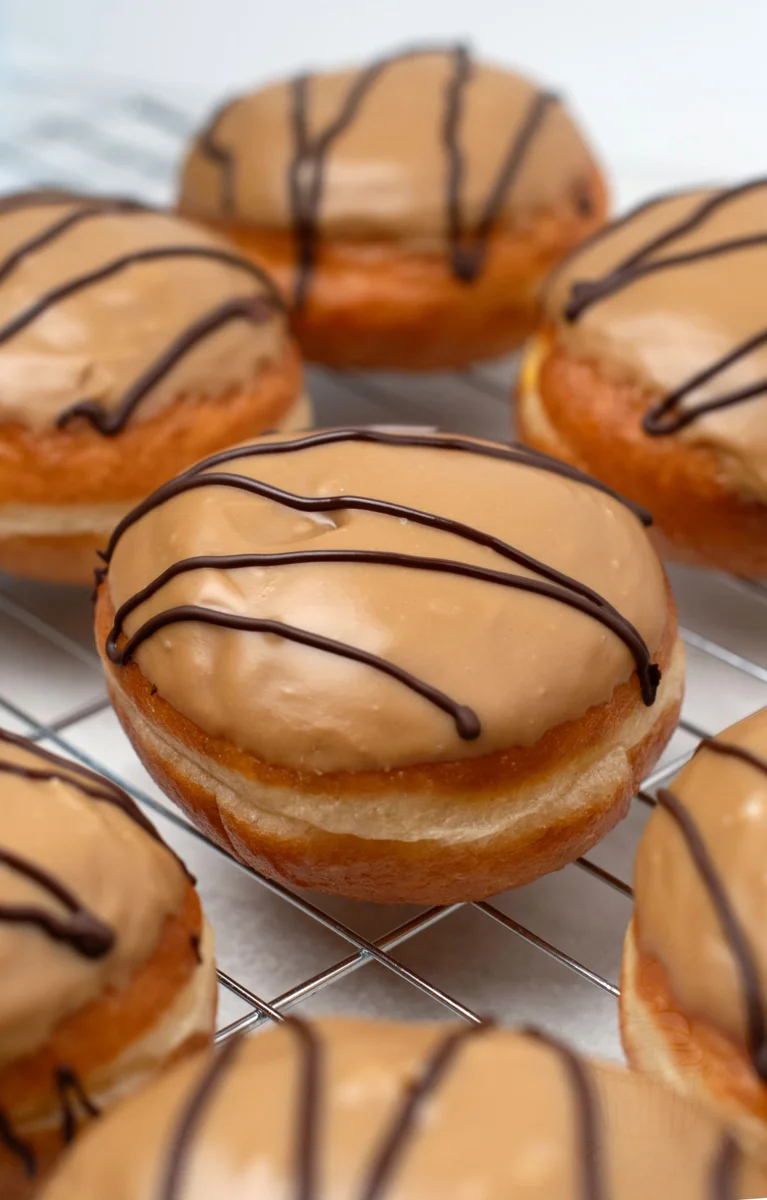
These homemade doughnuts are soft, fried yeast buns filled with custard and finished with a glossy brown-sugar fudge icing. They take time to rise, but make a special treat with a generous, creamy centre.
Ingredients
- 120 mlmilk
- 60 gblock margarine or butter
- 275 gstrong white flour
- 40 gcaster sugar
- 7 geasy-bake instant yeast (usually 1 sachet)
- 1free-range egg, beaten and at room temperature
- 100 gcustard
- 50 gsoft light brown sugar
- 50 gsoft dark brown sugar
- 50 gblock margarine or butter
- 3 tbspmilk
- 250 gicing sugar
- 50 gdark chocolate (optional)
Instructions
- 1
Warm milk and butter
Put the milk and 60 g of butter or margarine in a small saucepan. Warm gently until the fat begins to melt, then take the pan off the heat and let the mixture cool until it is no longer too hot to add to the other ingredients.
- 2
Mix the dough
Sift the flour and caster sugar into a large bowl, add the yeast and mix gently. Make a well in the centre, add the cooled milk mixture and beaten egg, then mix to form a soft, slightly sticky dough.
- 3
Knead until smooth
Turn the dough onto a well-floured surface and knead with floured hands, adding flour as needed. Knead for about 10 minutes, until smooth and stretchy.
- 4
Leave to rise
Put the dough in an oiled bowl and cover with oiled cling film or a damp tea towel. Leave it in a draught-free place for about 1 hour, or until doubled in size.
- 5
Shape the doughnuts
Knock back the risen dough and knead it briefly on a lightly floured surface. Divide it into 12 even pieces and roll them into balls. Set each ball on its own roughly 10 cm square of greaseproof paper, leaving space between them, then cover and leave in a draught-free place for about 1 hour, until roughly doubled in size.
- 6
Heat the oil
Heat oil in a large pan to 180°C (350°F), checking the temperature with a thermometer. Use enough oil for the doughnuts to fry without touching the bottom; the amount needed depends on the pan.
- 7
Fry the doughnuts
Use the paper squares to lift the doughnuts and carefully lower them into the hot oil. Fry for about 90 seconds, turn, then fry the other side for about 90 seconds. Work in small batches so the pan is not crowded and the oil temperature does not drop too quickly.
- 8
Drain and cool
When golden brown on both sides, lift each doughnut out with a slotted spoon and hold it above the oil for about 10 seconds. Transfer to a wire rack to cool, continuing to monitor and adjust the oil temperature between batches.
- 9
Fill with custard
Spoon the custard into a piping bag fitted with a large round nozzle. Once the doughnuts are cool enough to handle, make a small hole in the side of each with the end of a wooden spoon and pipe in custard; about a teaspoon per doughnut is usually suitable.
- 10
Start the fudge icing
For the fudge icing, put the light and dark brown sugars and the remaining 50 g of butter or margarine in a pan. Melt them gently over a low heat.
- 11
Mix the icing
Take the pan off the heat, add 3 tablespoons of milk and stir; the sugar should begin to dissolve. Add the icing sugar and mix until glossy. If it is too thick, add a little more milk, and use it straight away as it thickens on standing.
- 12
Dip and finish
Dip the top of each doughnut into the icing and let the excess drip away. If using the dark chocolate, drizzle it over the doughnuts after melting it.
What are fudge doughnuts?
These are filled yeast doughnuts: enriched dough is shaped into balls, fried until golden and filled with custard. Doughnuts have a long history in American baking, and this version pairs the familiar soft, fried dough with a sweet fudge-style topping.
The method relies on two rises for a light texture, followed by a short fry on each side. Filling the doughnuts after frying keeps the custard creamy and the icing adds a contrasting, glossy finish.
Nutrition and macros by portion
The nutrition label shows one serving as written: 410 calories, 6g protein, 62g carbs, 16g fat.
| Portion | Adjustment | kcal | Protein | Carbs | Fat |
|---|---|---|---|---|---|
| Lighter | Skip the chocolate drizzle | 287 kcal | 4g | 43g | 11g |
| This serving | As written | 410 kcal | 6g | 62g | 16g |
| Hungry | Serve two doughnuts | 615 kcal | 9g | 93g | 24g |
The flour, caster sugar and icing sugar provide most of the carbohydrates, while the butter or margarine, frying oil and chocolate contribute much of the fat. The egg and custard add some protein, though this is mainly a sweet, carbohydrate-rich treat. Pair a doughnut with fruit and a protein-rich snack such as yoghurt to make a more balanced plate.
The dough ingredients
Strong flour: its higher gluten content helps the dough become stretchy when kneaded, giving the doughnuts enough structure to puff up.
Yeast and egg: the yeast leavens the dough, while the egg and butter or margarine enrich it. Use the egg at room temperature as specified so it blends more readily into the dough.
Getting the rises right
First rise: cover the oiled dough and leave it somewhere draught-free until it has doubled, rather than relying only on the clock. The time can vary with the warmth of the room.
Second rise: shaping the dough into 12 balls before this rise helps them puff into evenly sized doughnuts. Give them space on the tray so they do not touch as they expand.
Frying safely and evenly
Oil temperature: aim for 180°C and use a thermometer for accuracy. If the oil is too cool, the doughnuts can absorb more oil; if it is too hot, they may colour before the centres cook.
Small batches: lower each doughnut carefully using its paper square, then fry for about 90 seconds per side. Keep the pan uncrowded and let the oil return to temperature between batches.
Filling and icing
Custard filling: wait until the doughnuts are cool enough to handle, then pierce each one at the side and pipe in about a teaspoon. The right amount depends on the size of the opening and your preference.
Fudge icing: add the icing sugar after taking the melted brown sugar and fat off the heat. Dip the doughnuts while the icing is still glossy and fluid, as it thickens if left to stand.
Serving ideas
Serve the doughnuts once the icing has set enough to handle, with tea or coffee. The optional dark chocolate drizzle adds a slight bitter edge to the sweet icing.
For a fuller dessert, serve one doughnut with fresh berries or sliced fruit. These add freshness alongside the rich dough, custard and topping.
Recipe notes & tips
- Let the milk and butter mixture cool before adding it to the yeast and egg.
- Use lightly floured hands to knead, adding flour only as needed so the dough does not become overly dry.
- Check the oil temperature before frying each batch and adjust the heat when necessary.
- Use a slotted spoon to drain each doughnut briefly above the pan before placing it on the rack.
- Pipe the custard in through a small side opening to help keep the filling inside.
- Prepare the icing close to the end of frying so it is still easy to dip into.
Variations
- Chocolate finish: drizzle melted dark chocolate over the fudge icing, as suggested in the recipe.
- Cinnamon sugar: dust the doughnuts lightly with cinnamon sugar instead of adding the chocolate drizzle.
- Vanilla custard: use vanilla custard for a fragrant, classic filling.
- Jam centre: swap the custard for a smooth fruit jam and pipe it in through the side.
- Smaller doughnuts: divide the dough into more pieces and check them earlier while frying, as smaller pieces cook more quickly.
Common mistakes to avoid
- Hot milk mixture: it can harm the yeast; let it cool before mixing it into the dough.
- Too much added flour: the dough can turn firm; add flour gradually while kneading.
- Skipping the second rise: the doughnuts may be dense; wait until the shaped balls have puffed up.
- Crowded pan: the oil temperature can fall and doughnuts may stick together; fry in small batches.
- Oil at the wrong temperature: the doughnuts can brown unevenly; monitor it with a thermometer.
- Icing left to stand: it thickens and becomes harder to dip into; use it as soon as it is mixed.
How to store
Store cooled doughnuts in an airtight container at room temperature and eat within 1 day for the best texture. They are best served fresh; reheating can soften the icing and affect the custard filling, so avoid warming them once filled.
Frequently asked questions
Can I make the dough ahead?
The recipe is written for two rises followed by frying. For best results, follow the timings and rise cues in the method, then fill and ice the doughnuts after they have cooled.
How do I know when the dough has risen enough?
For the first rise, look for the dough to double in size. After shaping, leave the balls until they have puffed up to roughly double their size.
Do I need a thermometer for the oil?
A thermometer is recommended to check for 180°C (350°F). Keeping the oil near this temperature helps the doughnuts colour and cook more evenly.
How much custard goes in each doughnut?
About a teaspoon per doughnut is suggested, though the amount depends on the size of the opening and how full you like them.
Can I leave out the chocolate?
Yes. The dark chocolate is optional, so the doughnuts can be finished with just the fudge icing.
Why has my fudge icing become too thick?
It thickens as it stands. Use it straight after mixing, or stir in a little more milk if it is already too thick to dip.
Cook it from the original
This recipe comes from bakingwithgranny.co.uk. Their page has the author’s own photos, notes and tips — the best place to cook it from.
Open the recipe on bakingwithgranny.co.uk