
Puff Pastry Mince Pies
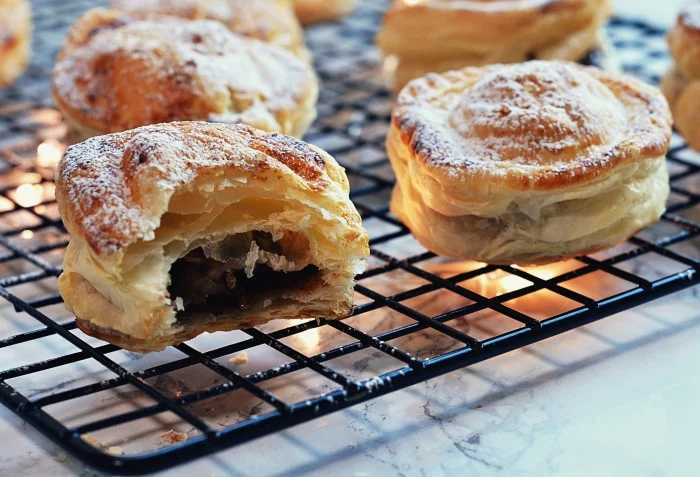
These puff pastry mince pies swap the usual shortcrust for crisp, flaky layers wrapped around sweet mincemeat. They make a festive bake in about 40 minutes, with simple assembly and a golden egg-washed finish.
Ingredients
- 320 gready-rolled puff pastry
- 200 gmincemeat
- 1free-range egg, beaten
- to tastecaster sugar or icing sugar, for dusting
Instructions
- 1
Heat the oven
Preheat the oven to 200°C, or 180°C for a fan oven, or Gas Mark 5. Grease a baking tray with butter or margarine.
- 2
Cut the bases
Roll out the puff pastry and cut out about 12 small circles, using a 48 mm cutter. Arrange them on the greased tray.
- 3
Add the filling
Put a heaped teaspoon of mincemeat on each pastry circle, making sure each spoonful includes some apple.
- 4
Cut the tops
From the remaining pastry, cut out the same number of circles, using a larger 58 mm cutter.
- 5
Seal the pies
Beat the egg and brush it around the edge of each filled base. Lay a larger pastry circle over each one and press gently with your fingers to seal.
- 6
Crimp the edges
Gently press the smaller cutter over each pie to settle the filling beneath the pastry. Press the edges down with a fork to help keep the mincemeat inside.
- 7
Glaze and vent
Brush the tops with the remaining egg wash, then pierce a few small holes in each pie.
- 8
Bake until golden
Bake in the preheated oven for 15–20 minutes, until the pastry is puffed and golden.
- 9
Cool and dust
When the pies are cool enough to handle, transfer them to a wire rack. Once completely cool, dust with caster or icing sugar.
What are mince pies?
Mince pies are a British festive pastry filled with mincemeat, a sweet mixture commonly made with dried fruit and spices. Despite the name, many modern versions are meat-free.
This version uses ready-rolled puff pastry instead of the more usual shortcrust. The larger pastry tops enclose the filling, while the egg wash helps seal the pies and gives them a glossy, golden surface.
Nutrition and macros by portion
The nutrition label shows one serving as written: 615 calories, 8g protein, 57g carbs, 34g fat.
| Portion | Adjustment | kcal | Protein | Carbs | Fat |
|---|---|---|---|---|---|
| Lighter | Use less pastry | 431 kcal | 6g | 40g | 24g |
| This serving | As written | 615 kcal | 8g | 57g | 34g |
| Hungry | Serve two pies | 923 kcal | 12g | 86g | 51g |
The puff pastry contributes most of the fat and a substantial share of the carbohydrates, while the mincemeat adds carbohydrates from its fruit and sugar. The egg adds a little protein and fat; serve a pie with fruit or yoghurt if you want to balance it with something fresh.
Choosing the pastry and filling
Ready-rolled pastry: Keep it cool while you cut the circles so it stays easier to handle. Gather and re-roll scraps gently if needed to make the tops.
Mincemeat: A heaped teaspoon gives each small base a generous centre. Include some apple in each spoonful, as the method specifies, and avoid adding so much that the edges become difficult to seal.
How to seal the pies
Egg wash: Brush around the filling rather than over it, so the pastry edges can stick together. Place the larger circle on top and press lightly to join the layers.
Fork and cutter: A gentle press with the smaller cutter helps settle the pastry around the filling; use the fork to close the edge. Keep the cutter pressure light so it does not cut through the pastry.
Getting the pastry right
Vent holes: Pierce a few small holes in each top before baking. They let steam escape as the pies heat and puff.
Doneness: Look for pastry that has risen and turned golden, using the stated 15–20 minute baking time as a guide. If the pies are still pale at 15 minutes, give them a little longer and check again.
Working with the pastry scraps
Cutting: The recipe uses about 12 small bases and an equal number of larger tops. Cut the bases first, then use the remaining pastry for the tops.
Handling: Try not to stretch the pastry as you transfer it to the tray or cover the filling. Gentle handling helps the layers puff in the oven.
Serving and cooling
Cooling: Let the pies firm up on the tray until they are cool enough to move, then transfer them to a wire rack. Dust only once they are completely cool so the sugar stays on the surface.
To serve: Offer them plain with tea or coffee, or serve alongside custard for a more substantial pudding.
Recipe notes & tips
- Keep the pastry cool while cutting and assembling the pies.
- Use a 48 mm cutter for the bases and a 58 mm cutter for the tops, as in the method.
- Make sure the egg wash stays around the edge of each base so the top can seal.
- Include some apple in each spoonful of mincemeat.
- Pierce a few small holes in every top before baking.
- Wait until the pies are fully cool before dusting them with sugar.
Variations
- Citrus note: Add a little finely grated orange zest to the mincemeat before filling the pies.
- Spiced filling: Stir a pinch of ground cinnamon into the mincemeat for a warmer spice flavour.
- Different sugar: Choose caster sugar for a finer dusting or icing sugar for a soft, pale finish.
- Smaller pies: Cut smaller matching bases and tops, then check them early as they may bake faster.
- Serve with custard: Pair a warm pie with custard to make it a more substantial dessert.
Common mistakes to avoid
- Overfilling the bases: Too much mincemeat makes sealing difficult; stick to a heaped teaspoon per pie.
- Weak seals: Filling caught between the pastry edges can let mincemeat escape; brush the edges with egg and press them together.
- Pressing too hard: Heavy pressure with the cutter can cut through the pastry; use a gentle touch to settle the filling.
- Skipping the vents: Unpierced tops can trap steam; make a few small holes in each one before baking.
- Dusting while warm: Sugar can disappear into warm pastry; wait until the pies are completely cool.
- Overbaking: Pastry can become too dark if left in too long; check for a puffed, golden finish from 15 minutes.
How to store
Keep cooled pies in an airtight container at room temperature and eat within 2 days. Reheat briefly in an oven until warmed through to refresh the pastry; avoid the microwave if you want to retain its crispness.
Frequently asked questions
Can I use shortcrust pastry instead?
Yes, but the pies will have a different, less layered texture. Use the same filling and follow the pastry package guidance if the baking time differs.
How much mincemeat goes in each pie?
The method calls for a heaped teaspoon per base. Keep it centred and leave the edge clear for sealing.
Can I make these without a round cutter?
A small glass or round pastry cutter can be used for the bases, with a slightly larger one for the tops. Aim for about 12 of each size.
Why do the tops need holes?
A few small holes let steam escape during baking. This helps prevent the tops from bulging unevenly.
How do I know when they are baked?
They should look puffed and golden after about 15–20 minutes. Check them from the 15-minute mark, as ovens can vary.
Can I freeze the baked pies?
Yes. Freeze them once fully cool in a suitable sealed container, then thaw and warm in the oven to help crisp the pastry.
Cook it from the original
This recipe comes from bakingwithgranny.co.uk. Their page has the author’s own photos, notes and tips — the best place to cook it from.
Open the recipe on bakingwithgranny.co.uk