
Almond, lemon and candied lemon galette des rois
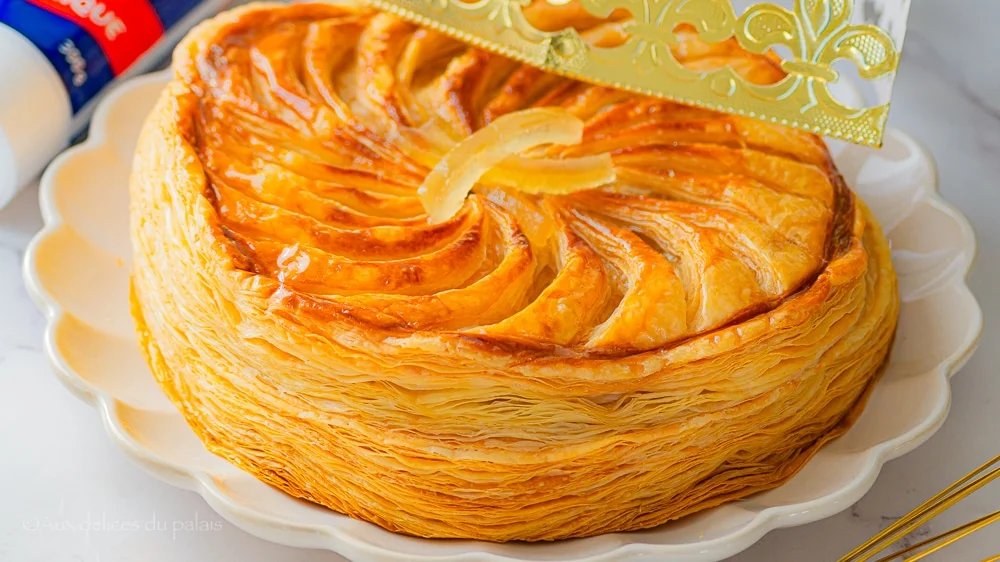
This French galette des rois layers crisp inverted puff pastry around almond cream flavoured with fresh lemon and candied peel, with white chocolate chips for extra sweetness. It is a celebratory bake that rewards careful chilling and makes a fragrant centrepiece for sharing.
Ingredients
- 150 mlcold water
- 1 tablespoonwhite wine vinegar
- 15 g fine Guérande salt or 18 g fleur de selfine salt or fleur de sel
- 350 gplain flour, type 55
- 115 gmelted butter, cooled
- 375 gsoft unsalted butter
- 150 gstrong flour, type 45
- 100 gground almonds
- 25 gcornflour or custard powder
- 80 gbutter
- 30 gicing sugar
- 50 gsweetened condensed milk
- 20 glemon juice
- Zest of 2untreated or organic lemons
- 40 gcandied lemon peel, finely chopped
- 60 g (1 large egg)egg, beaten
- 1 egg + 1 yolkegg and egg yolk
- 1 tablespoonwater
- 70 gwater
- 70 gsugar
- 1used vanilla pod or strip of lemon peel
- 30 gwhite chocolate chips
- 1porcelain bean or almond
- To decoratecandied lemon peel
Instructions
- 1
Make the dough
Mix the cold water and vinegar in a bowl, then stir in the salt. Add the flour and cooled melted butter. Knead by hand or with a stand mixer fitted with a dough hook until smooth and even.
- 2
Chill the dough
Fold baking paper to make a 15 × 18 cm rectangle and place the dough inside. Roll it out to fit the shape, then refrigerate for at least 2 hours.
- 3
Make the butter block
Mix the softened butter with the strong flour by hand or in a stand mixer fitted with the paddle attachment. Work it until the flour is fully incorporated and the mixture forms a dough.
- 4
Shape the butter
Fold baking paper into a 20 × 36 cm rectangle and enclose the butter-and-flour mixture inside. Roll it to fit, then refrigerate for at least 2 hours.
- 5
Enclose the dough
Remove the butter block from the fridge and peel away the paper. Set the 15 × 18 cm dough in its centre, fold the lower section of the butter block over it, then bring the upper section over to cover the dough completely. Seal any gaps, wrap the parcel in cling film and chill for 15 minutes.
- 6
Roll and fold
On a floured work surface, flour the parcel and roll it gently to 8–9 mm thick and about 60 cm long, keeping the rectangle regular and avoiding force that might crack the pastry. Fold the lower quarter towards the middle, fold the upper quarter down to meet it, then fold the whole piece in half like a book.
- 7
Chill the pastry
Wrap the pastry in cling film and refrigerate for 2 hours.
- 8
Repeat the fold
Turn the rested pastry by a quarter turn and roll it again to 8 mm thick. Repeat the previous folding sequence for another book fold, then chill for 2 hours.
- 9
Finish the folds
Roll the pastry lengthways to about 60 cm. Fold the top third down, then fold the bottom third over it for a single turn. Wrap and refrigerate for 2 hours.
- 10
Cut the pastry
Divide the pastry in half. On a floured surface, roll each piece to 3–4 mm thick and cut one 23 cm disc and one 24 cm disc from the second piece. Cover and chill the discs for 2 hours while you make the filling. The recipe uses about 800 g of pastry; stack and freeze the remainder for another use.
- 11
Cream the butter
In a bowl or a stand mixer fitted with the paddle attachment, work the softened butter until creamy.
- 12
Mix the filling
Add the icing sugar, sweetened condensed milk, ground almonds and cornflour or custard powder. Mix to combine.
- 13
Add the egg
Gradually mix in the previously beaten egg.
- 14
Flavour the cream
Mix in the lemon zest, lemon juice and finely chopped candied peel. Refrigerate the almond cream for 15 minutes.
- 15
Prepare the glaze
Mix the egg yolk, whole egg and 1 tablespoon of water. Cover and keep refrigerated.
- 16
Make the syrup
Bring 70 g water and 70 g sugar to the boil in a saucepan with the used vanilla pod or lemon peel. Simmer gently for 5 minutes, then remove from the heat and leave at room temperature.
- 17
Heat the oven
Preheat the oven to 200°C.
- 18
Fill the base
Place the 23 cm pastry disc on a baking tray lined with baking paper or a baking mat. Spread the almond cream over it, leaving a 2 cm border; take the cream out of the fridge 10 minutes beforehand. Hide the bean or almond in the filling and scatter over the white chocolate chips.
- 19
Seal the galette
Dampen the pastry border, lay the 24 cm disc on top and press the edges together to seal. Freeze the assembled galette for 30 minutes.
- 20
Glaze and score
Take the galette out of the freezer and lightly brush the top with the egg glaze. Score a pattern with a knife, then prick the pastry with a cocktail stick to let steam escape.
- 21
Bake the galette
Put the galette in the oven, then reduce the temperature to 170°C and bake for about 45 minutes.
- 22
Glaze and cool
As soon as the galette comes out of the oven, brush it with the syrup. Leave it to cool on a wire rack before serving.
- 23
Add the decoration
Finish by decorating the galette with candied lemon peel.
What is galette des rois?
Galette des rois is a French puff-pastry cake traditionally shared around Epiphany, often with a hidden bean or charm inside. The person who finds it is crowned king or queen for the occasion.
This version combines the familiar almond filling with lemon zest, juice and candied peel, plus white chocolate chips. The bright citrus cuts through the rich butteriness of the pastry and cream.
Nutrition and macros by portion
The nutrition label shows one serving as written: 450 calories, 0g protein, 0g carbs, 0g fat.
| Portion | Adjustment | kcal | Protein | Carbs | Fat |
|---|---|---|---|---|---|
| Lighter | Smaller slice, fresh fruit | 315 kcal | 0g | 0g | 0g |
| This serving | As written | 450 kcal | 0g | 0g | 0g |
| Hungry | Larger slice | 675 kcal | 0g | 0g | 0g |
The pastry and butter provide most of the fat, while the flour, sugar and condensed milk contribute carbohydrates; the almonds add some protein and fat. Pair a slice with fresh fruit, or serve it after a lighter savoury meal to balance the plate.
Why use inverted puff pastry?
In this method, the flour-and-butter block wraps around the separate dough, rather than the dough enclosing the butter. The repeated folds and rests build the layers that puff in the oven.
Keep both components cold and roll with a light hand. If the butter block softens or the pastry starts to resist, pause and chill it before continuing.
Getting the folds right
Even rectangles: Aim for straight edges and an even thickness so the layers fold neatly and bake consistently. The baking-paper templates help shape the initial dough and butter block.
Rest between turns: The method includes several 2-hour chilling periods, followed by a final 2-hour rest for the cut discs. These pauses make the pastry easier to roll and help keep the butter cool.
Make a balanced almond filling
Creamy butter: Beat the softened butter until smooth before adding the other filling ingredients, so the mixture blends without lumps.
Citrus and texture: Add the beaten egg gradually, then mix in the zest, juice and finely chopped candied peel. Chill the finished cream for 15 minutes so it is easier to spread.
Seal and bake evenly
Leave a clear border: Spread the filling over the 23 cm base but keep it 2 cm from the edge. Dampen the border before adding the larger disc, then press the pastry edges together securely.
Steam and colour: The brief freeze firms the assembled galette before glazing and scoring. Pricking the top gives steam a way out; bake at 170°C for about 45 minutes after lowering the oven from 200°C.
Serving and timing
The recipe takes about 120 minutes in total, but its pastry method includes long chilling stages, so plan around the stated rests. The pastry offcuts can be stacked and frozen for another use.
Serve the galette once it has cooled on a wire rack, when the layers are easier to cut cleanly. It is rich enough to enjoy on its own, or with fresh fruit alongside.
Recipe notes & tips
- Measure the pastry rectangles with folded baking paper to keep their shapes even.
- Work on a lightly floured surface and avoid pressing hard if the pastry begins to crack.
- Give the almond cream 10 minutes out of the fridge before spreading it over the pastry.
- Keep the filling 2 cm away from the edge so the pastry can be sealed securely.
- Use a cocktail stick to prick the top after scoring so steam can escape during baking.
- Brush on the syrup as soon as the galette comes out of the oven.
Variations
- Use fleur de sel: Choose 18 g fleur de sel instead of 15 g fine Guérande salt.
- Choose the thickener: Use custard powder instead of cornflour in the almond cream.
- Change the syrup aroma: Simmer the sugar syrup with the used vanilla pod or a strip of lemon peel.
- Make the filling without chocolate: Leave out the white chocolate chips for a more direct almond-and-lemon flavour.
- Use an almond: Hide an almond in the filling instead of a porcelain bean.
Common mistakes to avoid
- Soft butter block: Chill it until firm before enclosing the dough, so the layers remain distinct.
- Cracked pastry: Roll gently and stop rather than forcing the pin; let the pastry rest in the fridge.
- Filling too close to the edge: Leave a 2 cm border so the two pastry discs can seal.
- Loose seal: Dampen the border and press the pastry edges together before chilling.
- Skipped steam holes: Prick the scored top with a cocktail stick to help steam escape.
- Syrup added later: Brush it on as soon as the galette leaves the oven, as directed.
How to store
Once cool, cover and refrigerate any leftover galette and eat within 2 days. Reheat slices in a low oven until warmed through to help the pastry regain some crispness.
Frequently asked questions
Can I make the pastry ahead?
Yes. The recipe already relies on several chilled rests, and the remaining pastry can be stacked and frozen for another use.
Can I use ready-made puff pastry?
The recipe is written for homemade inverted puff pastry, so ready-made pastry will change the method and result. If using it, follow the packet’s handling instructions.
Why does the filling need to stay away from the edge?
The 2 cm clear border gives you room to seal the pastry discs together and helps keep the filling enclosed.
How do I know when the galette is baked?
Bake for about 45 minutes at 170°C after lowering the oven temperature from 200°C. The pastry should be well browned before you take it out.
Do I have to use the vanilla pod in the syrup?
No. The recipe gives a strip of lemon peel as an alternative.
Can I skip the hidden bean?
Yes. It is optional; the recipe suggests a porcelain bean or an almond.
Cook it from the original
This recipe comes from auxdelicesdupalais.net. Their page has the author’s own photos, notes and tips — the best place to cook it from.
Open the recipe on auxdelicesdupalais.net