
Rice Pudding Trifle
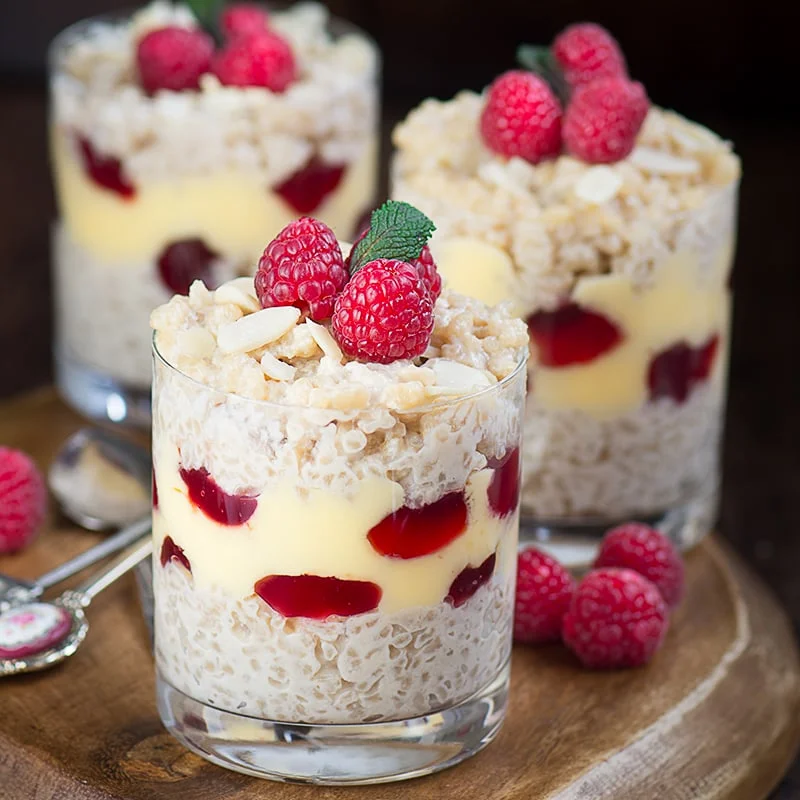
This British-style trifle layers creamy baked rice pudding with custard and raspberry jam, then finishes with almonds and fresh raspberries. It brings two familiar desserts together in a spoonable pudding that can be assembled in glasses or served from a bowl.
Ingredients
- 150 gpudding rice
- 75 glight brown muscovado sugar
- 150 mldouble cream
- 700 mlmilk
- 2bay leaves
- 300 gcustard
- 80 g (4 heaped tsp)raspberry jam
- A fewflaked almonds
- A fewfresh raspberries
Instructions
- 1
Heat the oven
Preheat the oven to 180°C, or 160°C fan.
- 2
Bake the rice
Put the pudding rice, muscovado sugar, double cream, milk and two bay leaves into an ovenproof dish. Cover with the lid and bake for 1 hour 20 minutes.
- 3
Check the rice
Carefully check whether the rice is cooked, taking care because it will be extremely hot. If it needs longer, return it to the oven for another 10 minutes.
- 4
Make the custard
If you are making your own custard, prepare it now.
- 5
Cool the puddings
Once the rice pudding and custard are cooked, leave them to cool slightly for 5 minutes. Remove the bay leaves before serving.
- 6
Layer the glasses
For individual servings, divide half the rice pudding between 4 glasses and press it down gently with the back of a spoon. Add 5 dots of jam around the edge of each glass, pour in the custard, then add 5 more dots of jam. Spoon the remaining rice pudding on top without pressing it down, so it does not mix into the custard. Finish with flaked almonds and a few raspberries, then serve.
- 7
Serve in a bowl
Alternatively, put everything into a bowl and serve, without layering it into glasses.
What is rice pudding trifle?
A trifle is a British layered dessert, traditionally assembled with contrasting soft, creamy and fruity elements. This version pairs baked rice pudding with custard and raspberry jam for a combination of two familiar puddings.
The rice cooks slowly with milk, cream and muscovado sugar, while bay leaves add an unusual aromatic note. Layering the components keeps their different textures and flavours distinct.
Nutrition and macros by portion
The nutrition label shows one serving as written: 587 calories, 15g protein, 66g carbs, 29g fat.
| Portion | Adjustment | kcal | Protein | Carbs | Fat |
|---|---|---|---|---|---|
| Lighter | Use less cream and jam | 411 kcal | 10g | 46g | 20g |
| This serving | As written | 587 kcal | 15g | 66g | 29g |
| Hungry | Serve a larger portion | 881 kcal | 22g | 98g | 44g |
The rice and sugar provide most of the carbohydrates, while the double cream and milk contribute much of the fat; the custard also adds fat and some protein. Serve a glass alongside fresh fruit to add a lighter, fresh contrast to the creamy layers.
The baked rice pudding
Rice: Pudding rice is the short-grain choice here; it softens as it bakes and releases starch into the milk mixture.
Dairy: Milk and double cream make the base rich and creamy. Use an ovenproof dish with a lid so the mixture can bake covered.
The bay leaf secret
Bay leaves: They infuse the rice pudding as it cooks, giving it a gentle savoury fragrance that sets this version apart. Remove both leaves before assembling or serving.
Muscovado sugar: Its deeper, caramel-like flavour complements the creamy rice and tart-sweet raspberry jam.
Getting the texture right
Doneness: Check the rice carefully after 1 hour 20 minutes. If it is not quite tender, give it the additional 10 minutes specified in the method.
Layering: Press the first rice layer down gently, but leave the top layer loose. This helps keep the custard in a separate middle layer rather than squashing it into the rice.
Timing and cooling
Bake: The rice pudding needs 1 hour 20 minutes in the oven, with a further 10 minutes if needed. Allow for the oven to heat before baking.
Cool: Let the cooked rice pudding and custard stand for 5 minutes before assembling, and remove the hot bay leaves with care.
Serving the trifle
Glasses: Dividing the layers between 4 glasses shows off the jam and custard. Add the jam in small dots around the edges as directed.
Bowl: For a simpler presentation, combine the components in a serving bowl instead. Add the almonds and raspberries on top just before serving.
Recipe notes & tips
- Use an ovenproof dish with a lid for baking the rice.
- Check the rice carefully after the stated baking time, as the dish will be very hot.
- Remove the bay leaves before building the layers.
- Keep the top layer of rice pudding loose so it does not mix into the custard.
- Use seedless raspberry jam if you prefer a smooth finish.
- Add the almonds and raspberries just before serving for a fresh-looking topping.
Variations
- Seedless jam: Choose seedless raspberry jam for a smoother layer.
- Different berries: Use another fresh berry in place of the raspberries on top.
- Extra fruit: Add a few more fresh raspberries between the layers.
- Bowl presentation: Assemble the components in one bowl instead of individual glasses.
- Custard choice: Use homemade custard or 300 g of prepared custard.
Common mistakes to avoid
- Skipping the lid: The recipe calls for covered baking; cover the ovenproof dish while the rice cooks.
- Undercooked rice: Check it after 1 hour 20 minutes and return it to the oven for 10 minutes if needed.
- Leaving in the bay leaves: Remove both leaves before serving.
- Pressing the top layer: Spoon it on without squashing, or it may mix into the custard.
- Assembling while piping hot: Let the rice pudding and custard cool slightly for 5 minutes first.
How to store
Cover and refrigerate leftovers, and eat within 2 days. Serve chilled or reheat gently until warm; the layered appearance may not hold after reheating.
Frequently asked questions
Can I use ready-made custard?
Yes. The recipe calls for 300 g of custard, so prepared custard can be used in that amount.
How do I know when the rice pudding is cooked?
Check the rice carefully after 1 hour 20 minutes. If it is not quite done, bake it for another 10 minutes.
Can I serve this in one bowl?
Yes. Put the components into a bowl instead of layering them in glasses; the method notes that the look will be less structured, but it will still be suitable for serving.
Do I have to use bay leaves?
They are part of this recipe and provide its unusual aromatic note. Remove them before serving, as they are used for infusing rather than eating.
Can I assemble the glasses ahead of time?
You can assemble them ahead and keep them covered in the fridge, though the almonds may soften. For the best texture, add the topping close to serving.
Cook it from the original
This recipe comes from charlotteslivelykitchen.com. Their page has the author’s own photos, notes and tips — the best place to cook it from.
Open the recipe on charlotteslivelykitchen.com