
Hasselback Potatoes
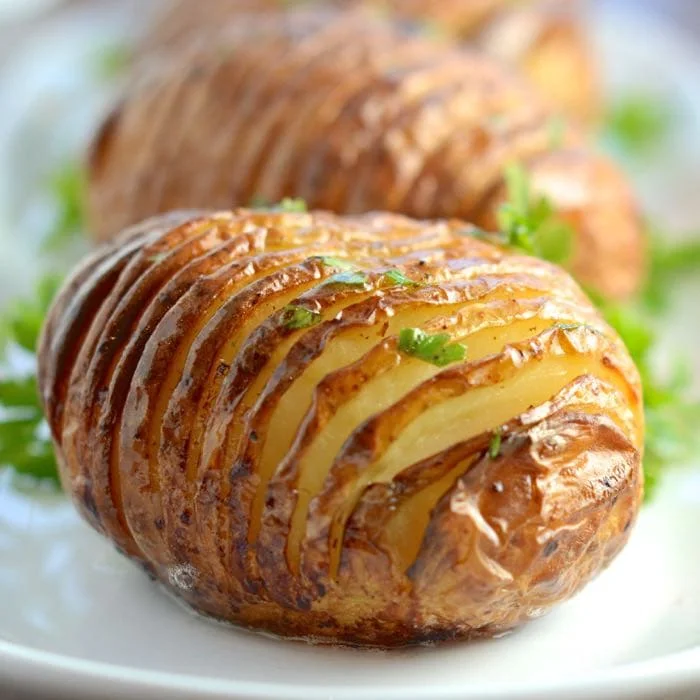
Hasselback potatoes are Swedish baked potatoes sliced into thin, connected layers that fan out in the oven. They make a crisp-edged, buttery side dish with a soft centre and look special without complicated preparation.
Ingredients
- 4 medium (approximately 175 g each)baking potatoes
- 20 mlolive oil
- 20 gbutter
- to tastesalt
Instructions
- 1
Preheat the oven
Heat the oven to 220°C, or 200°C fan.
- 2
Slice the potatoes
With a sharp knife, make slits about 0.5 cm apart along each potato, cutting roughly two-thirds of the way through. Keep the base intact so the potato holds together; if you cut all the way through by mistake, the recipe can still work.
- 3
Add butter and oil
Put 5 g of butter on top of each potato, then drizzle 5 ml of olive oil over each one.
- 4
Season with salt
Sprinkle the potatoes with salt.
- 5
Bake and baste
Bake for 1 hour 10 minutes, adjusting the time if your potatoes are larger or smaller. About every 20 minutes, brush them with the butter and oil in the dish. If the ends are becoming very crisp, loosely cover the potatoes with a square of aluminium foil after 40 minutes.
- 6
Check the centres
After 1 hour 10 minutes, test the centre of a potato with a knife. If it is not soft, return the potatoes to the oven for a little longer.
- 7
Serve the potatoes
Once the centres are soft, take the potatoes out of the oven and serve.
What are Hasselback potatoes?
Hasselback potatoes are a Swedish way of baking potatoes with closely spaced cuts that leave the base attached. The slices open slightly as they cook, giving the outside plenty of edges to crisp while the middle stays tender.
This version relies on simple seasoning, butter and olive oil. Basting during the long bake helps coat the exposed layers and encourages an evenly golden finish.
Nutrition and macros by portion
The nutrition label shows one serving as written: 181 calories, 4g protein, 21g carbs, 9g fat.
| Portion | Adjustment | kcal | Protein | Carbs | Fat |
|---|---|---|---|---|---|
| Lighter | Use less butter and oil | 127 kcal | 3g | 15g | 6g |
| This serving | As written | 181 kcal | 4g | 21g | 9g |
| Hungry | Add another potato | 272 kcal | 6g | 32g | 14g |
The potatoes provide most of the carbohydrate, while the olive oil and butter contribute most of the fat. There is a small amount of protein in the potatoes; pair a potato with a protein-rich main and vegetables for a more balanced plate.
Choosing the potatoes
Baking potatoes: Choose four medium potatoes of roughly 175 g each so they cook in the stated time. Larger ones can be used, but will need longer in the oven.
Even sizing: Potatoes of similar size are more likely to finish together. If they vary, check each one for tenderness rather than assuming they are all done at once.
Making the cuts
Spacing: Aim for slits about 0.5 cm apart to create plenty of edges without separating the slices.
Depth: Cut about two-thirds of the way through, keeping the bottom intact. A careful, steady cut helps the potato hold its shape while it fans open as it bakes.
Butter, oil and basting
Butter and oil: The recipe portions 5 g of butter and 5 ml of olive oil over each potato. The butter brings richness, while the oil helps coat the surface.
Basting: Brush the potatoes with the fat in the dish about every 20 minutes. This is also a chance to check whether the tips are browning faster than the rest.
Getting the texture right
Crisp edges: The thin exposed slices can turn crisp in the oven, while the thicker centre remains soft. If the ends are becoming too crisp, loosely cover the potatoes with foil after 40 minutes.
Doneness: Check the middle with a knife after 1 hour 10 minutes. If it does not pass through the centre easily, bake for a little longer and check again.
Timing and serving
Oven time: Allow 1 hour 10 minutes for medium potatoes, with extra time if you choose larger ones. The knife test is more reliable than the clock alone when sizes differ.
On the plate: Serve them alongside roasted vegetables, salad or a main dish that suits a buttery potato side. Their crisp layers make them a good alternative to a plain baked potato.
Recipe notes & tips
- Use a sharp knife so the cuts are clean and controlled.
- Keep the bottom of each potato connected so it stays in one piece.
- Use potatoes of similar size for more even cooking.
- Baste about every 20 minutes using the fat collected in the dish.
- Loosely cover the potatoes with foil after 40 minutes if their ends are getting too crisp.
- Test the centre with a knife before serving, and give the potatoes more time if needed.
Variations
- Add garlic: Brush a little finely chopped garlic over the potatoes near the end of baking so it does not brown too much.
- Use herbs: Scatter chopped rosemary or thyme over the potatoes before they go into the oven.
- Add cheese: Sprinkle grated cheese over the potatoes towards the end of baking.
- Try paprika: Season with a little paprika along with the salt for a savoury variation.
- Finish with spring onion: Scatter sliced spring onion over the potatoes just before serving.
Common mistakes to avoid
- Cutting through the base: The slices can separate; stop about two-thirds of the way through each potato.
- Uneven cuts: Thick and thin sections cook differently; keep the slits roughly 0.5 cm apart.
- Skipping the basting: The exposed layers may dry out; brush them with the butter and oil about every 20 minutes.
- Relying only on the timer: Potato size affects cooking time; check the centre with a knife after 1 hour 10 minutes.
- Leaving tips to over-brown: If they become very crisp, loosely cover the potatoes with foil after 40 minutes.
How to store
Cool leftovers and refrigerate them in a covered container for up to 3 days. Reheat in an oven until hot throughout; the edges may be less crisp after storage.
Frequently asked questions
Can I use larger potatoes?
Yes. The recipe allows for larger potatoes, but they will take longer to cook. Check that the centre is soft before serving.
What if I cut all the way through a potato?
The recipe can still work if a potato separates. Handle it carefully when basting and serving.
How do I know when the potatoes are done?
After 1 hour 10 minutes, insert a knife into the centre. If the potato is not soft there, return it to the oven for a little longer.
Why cover the potatoes with foil?
The foil helps stop the ends from becoming too crisp. Cover them loosely after 40 minutes if you notice the tips browning quickly.
Can I prepare them ahead?
They are best served straight from the oven for the crispest edges. You can reheat refrigerated leftovers in the oven, though their texture may soften.
Cook it from the original
This recipe comes from charlotteslivelykitchen.com. Their page has the author’s own photos, notes and tips — the best place to cook it from.
Open the recipe on charlotteslivelykitchen.com