
Challah de Mazapán y Naranja
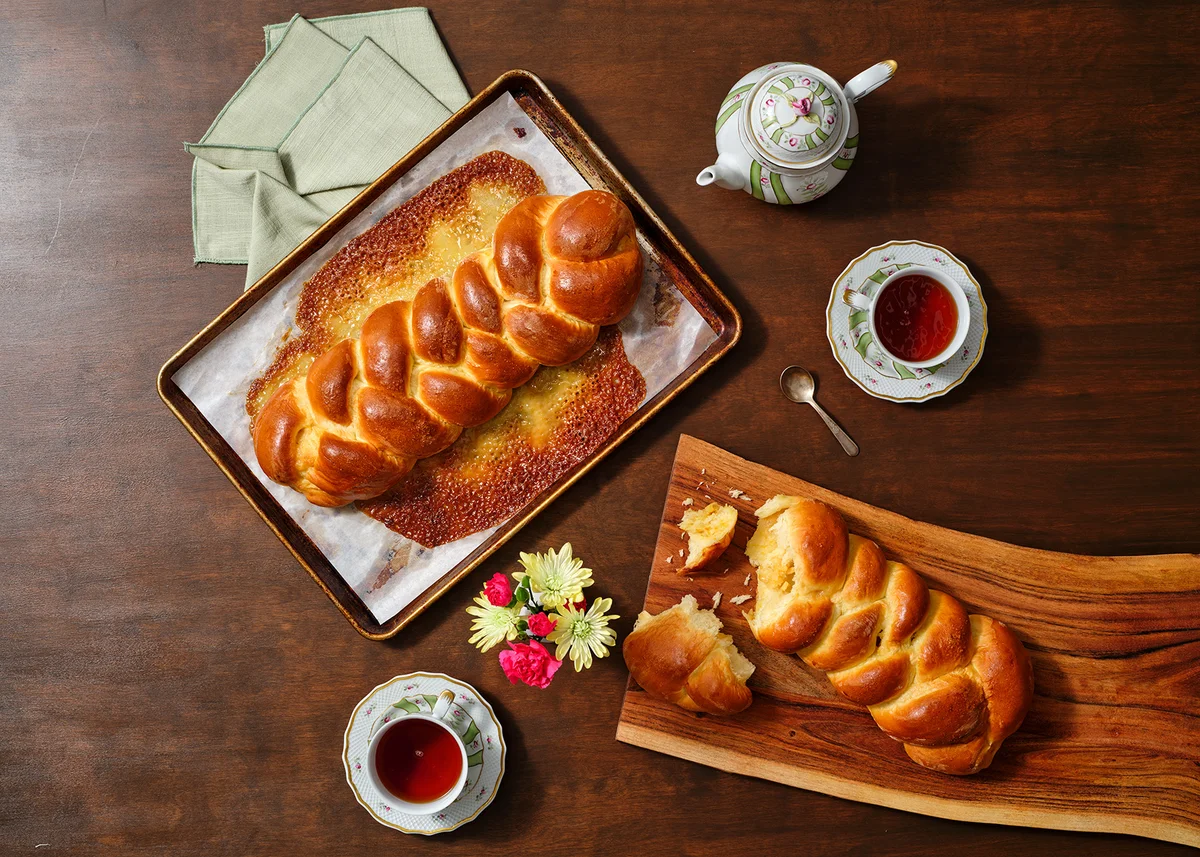
This enriched challah is braided around a sweet marzipan, butter and orange-zest filling, with orange blossom water adding a floral note. It makes two generous loaves for a festive table or a special weekend bake.
Ingredients
- 315 mlwater, at room temperature
- 2 teaspoonsactive dried yeast
- 30 mlorange blossom water
- 660 g, plus extra for kneadingplain flour
- 2 large eggs, plus 1 for the egg washeggs
- 67 ggranulated sugar
- 2 teaspoons, plus extra for sprinklingkosher salt
- 57 gunsalted butter, at room temperature
- 198 gmarzipan, of the best possible quality
- 100 ggranulated sugar
- 99 gunsalted butter, at room temperature and cut into small pieces
- 24 gplain flour
- 1 tablespoonorange zest
Instructions
- 1
Mix the dough
Add the water and yeast to the bowl of a stand mixer fitted with a dough hook, then stir with a small whisk or fork. Mix in the orange blossom water, followed by the flour, 2 eggs, sugar and salt.
- 2
Knead the dough
Mix at medium speed. After a couple of minutes, add the butter and continue mixing for about 3–4 minutes, until the dough gathers around the hook; scrape down the sides if needed.
- 3
Let dough rise
Lightly flour the work surface and scrape out the dough. Stretch and pull it with both hands, fold it, turn it a quarter-turn clockwise and repeat three more times. Put it in a lightly floured bowl, cover with a clean tea towel and leave in a warm, draught-free place for an hour, until almost doubled in size.
- 4
Make the filling
While the dough rises, break the marzipan into small pieces in a medium bowl. Press and mix it with the sugar until combined, then work in the butter with your fingers to make a paste. Add the flour and orange zest and mix.
- 5
Shape the strands
Punch down the risen dough and turn it onto a lightly floured surface. Divide it into 6 pieces as evenly as possible. Roll each piece into a rectangle about 38 cm by 10–13 cm. Spread one-sixth of the filling along an edge, roll the dough around it and pinch the edges and ends closed. Roll each strand gently to shape it, then repeat with the remaining dough and filling.
- 6
Braid the loaves
Line two baking sheets with baking parchment. Pinch three filled strands together at one end, braid them and pinch the other end closed. Tuck both ends underneath if needed to secure the shape. Repeat with the other three strands.
- 7
Proof the loaves
Place one challah on each prepared baking sheet, cover with a clean tea towel and leave in a warm, draught-free place for a couple of hours, until nearly doubled in size.
- 8
Heat the oven
Preheat the oven to 175°C, with racks in the lower and upper thirds.
- 9
Brush with egg
Lightly beat the remaining egg in a small bowl. Brush it over the loaves and sprinkle them lightly with salt.
- 10
Bake the challah
Bake for 15 minutes. Swap the loaves between the lower and upper thirds of the oven, then bake for another 10 minutes, until browned. Remove from the oven and, once cool enough to handle, transfer to a serving plate. Serve warm or keep covered until ready to eat.
- 11
Store leftovers
Keep leftover challah in an airtight container; it should stay soft for about 5 days.
What is marzipan challah?
Challah is a braided Jewish bread traditionally associated with Shabbat and holidays. This version, from Pati’s Mexican Table, brings together the enriched dough of challah and a sweet filling of marzipan, orange zest and butter.
The combination makes each slice fragrant and tender, with a soft, almond-rich centre. Orange blossom water in the dough reinforces the citrus-floral flavour without making the filling do all the work.
Nutrition and macros by portion
The nutrition label shows one serving as written: 2700 calories, 59g protein, 426g carbs, 89g fat.
| Portion | Adjustment | kcal | Protein | Carbs | Fat |
|---|---|---|---|---|---|
| Lighter | Use less filling | 1890 kcal | 41g | 298g | 62g |
| This serving | As written | 2700 kcal | 59g | 426g | 89g |
| Hungry | Serve a larger slice | 4050 kcal | 89g | 639g | 134g |
The flour and sugars provide most of the carbohydrates, while the butter, marzipan and eggs contribute much of the fat; the eggs and marzipan also add some protein. The estimate treats the two loaves as two servings, so a practical way to balance a portion is to serve it with fruit and plain yoghurt.
Building an enriched dough
Dough ingredients: the eggs and butter enrich the flour-based dough, while yeast gives it lift. Add the butter after the first couple of minutes of mixing, as directed, so the dough can begin to come together before the fat is incorporated.
Mixing cue: the dough should gather around the dough hook after a few more minutes of mixing. If it clings to the bowl, scrape down the sides as you go.
Working with the filling
Marzipan paste: break the marzipan into small pieces and press it with the sugar before adding the butter. Mixing the butter in with your fingers helps form a spreadable paste; the flour and zest finish the filling.
Even portions: divide the filling into six portions for the six dough rectangles. Spreading it along one edge makes it easier to enclose as you roll each strand.
Sealing and braiding
Seal the strands: pinch the long seam and both ends closed around the filling, then roll each strand gently to neaten it. A secure seam helps keep the filling inside as the dough rises and bakes.
Braid gently: join three strands at one end and braid without pulling them tight. Tuck the ends underneath to give each loaf a tidy finish.
Proofing and doneness
First rise: leave the covered dough in a warm, draught-free place for an hour, until it has almost doubled. The second rise takes a couple of hours and should bring the shaped loaves close to twice their size.
Baking cue: the loaves bake at 175°C for 15 minutes, then for 10 minutes more after you swap their oven positions. Look for a browned surface before taking them out.
Serving the loaves
Serve the challah warm from the oven, or keep it covered until you are ready to eat. The fragrant filling makes it well suited to a breakfast or brunch table, or as a sweet finish to a meal.
For a more balanced plate, pair a slice with plain yoghurt and fresh fruit rather than serving it alongside other sweet pastries.
Recipe notes & tips
- Have the butter at room temperature so it blends smoothly into both the dough and filling.
- Use a warm spot without draughts for both rises, and check the dough's size rather than relying on the clock alone.
- Divide the filling into six portions before shaping to make it easier to distribute evenly.
- Pinch the seams and ends firmly so the filling stays enclosed.
- Keep the loaves covered after baking if you are not serving them straight away.
Variations
- More orange: add extra orange zest to the filling for a stronger citrus note.
- Floral accent: use a little more orange blossom water in the dough for a more pronounced aroma.
- Almond finish: scatter sliced almonds over the egg wash before baking.
- Smaller braids: divide the dough and filling into more equal portions and braid shorter strands.
- Simple topping: omit the salt sprinkle if you prefer a less savoury finish.
Common mistakes to avoid
- Adding butter too early: let the dough mix for a couple of minutes first, then add the butter as directed.
- Skipping the rises: allow both rises to finish until the dough and shaped loaves have nearly doubled.
- Overfilling strands: divide the filling evenly into six portions so each strand can be sealed.
- Loose seams: pinch the dough edges and ends closed before rolling the strands into shape.
- Tight braiding: braid the strands gently so they have room to expand during the second rise.
How to store
Keep leftover challah in an airtight container at room temperature for about 5 days. Serve at room temperature or warm gently before eating.
Frequently asked questions
Can I make the dough without a stand mixer?
The method uses a stand mixer and dough hook. You can mix and knead by hand, working the butter in after the dough ingredients have started to come together.
How do I know when the dough has risen enough?
After the first rise it should be almost doubled in size; after shaping, the loaves should nearly double. Use these size cues as well as the stated timings.
Can I prepare the filling while the dough rises?
Yes. The method makes the filling during the first rise, so it is ready when you shape the dough.
Why is the egg wash used?
It is brushed over the loaves before baking, alongside a light sprinkle of salt. The recipe does not specify a substitute.
Can I freeze the baked challah?
The recipe gives storage guidance for an airtight container at room temperature, but does not specify freezing instructions.
How long does this recipe take?
Although the listed total time is 25 minutes, the method also includes an hour-long first rise and a second rise of a couple of hours, plus baking. Allow considerably more time for the full process.
Cook it from the original
This recipe comes from patijinich.com. Their page has the author’s own photos, notes and tips — the best place to cook it from.
Open the recipe on patijinich.com