
Homemade Chimichurri
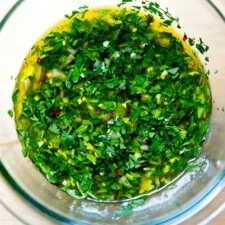
Homemade chimichurri is a vivid, uncooked sauce of parsley, coriander, garlic, vinegar and olive oil. Stir it together in minutes to serve with grilled meat, fish or vegetables.
Ingredients
- 30 ml (2 tablespoons)finely minced shallots
- 5 ml (1 teaspoon), from 1 small clovefinely minced garlic
- 1.25 ml (1/4 teaspoon)salt
- 2.5 ml (1/2 teaspoon), or to tastecrushed red pepper flakes
- 60 ml (1/4 cup)white balsamic vinegar
- 60 ml (1/4 cup)finely chopped parsley
- 60 ml (1/4 cup)finely chopped coriander
- 80 ml (1/3 cup)extra-virgin olive oil
Instructions
- 1
Macerate the aromatics
Put the shallots, garlic, salt, crushed red pepper flakes and vinegar in a bowl and stir. Leave to macerate for 5 minutes while you chop the herbs, if you have not already done so.
- 2
Stir in herbs
Add the herbs and olive oil, then stir to combine. Taste and adjust with more salt, vinegar or olive oil as you like.
- 3
Chill the sauce
Transfer the chimichurri to a jar and keep it in the fridge for up to a week.
What is chimichurri?
Chimichurri is an uncooked herb sauce associated with Argentina and Uruguay, often served alongside grilled meat, fish or vegetables. This version combines parsley and coriander with shallots, garlic, vinegar and olive oil.
The short maceration gives the shallots and garlic a little time in the vinegar before the herbs and oil go in. The result is bright, savoury and easy to adjust to taste.
Nutrition and macros by portion
The nutrition label shows one serving as written: 670 calories, 2g protein, 10g carbs, 73g fat.
| Portion | Adjustment | kcal | Protein | Carbs | Fat |
|---|---|---|---|---|---|
| Lighter | Use less olive oil | 469 kcal | 1g | 7g | 51g |
| This serving | As written | 670 kcal | 2g | 10g | 73g |
| Hungry | Serve a larger spoonful | 1005 kcal | 3g | 15g | 110g |
Most of this sauce's energy and fat come from the olive oil; the shallots and herbs contribute a small amount of carbohydrate, while the herbs add a little protein and fibre. Serve a spoonful alongside a protein-rich main and vegetables, with potatoes or bread if you want more carbohydrate.
Choose the ingredients
Shallots: Finely mince them so they disperse through the sauce. Finely diced red or white onion can stand in for shallots.
Herbs: The recipe uses equal volumes of parsley and coriander, but either herb can be used on its own. Chop them finely so they mix evenly with the oil and vinegar.
Vinegar: White balsamic brings acidity with a gentle sweetness. Red wine vinegar, lemon juice, lime juice or a mix can be used instead.
Give the aromatics a head start
The first five-minute rest is the only waiting time in the method. Stir the shallots, garlic, salt and chilli flakes into the vinegar, then use the pause to finish chopping the herbs.
If raw garlic tastes too strong for you, leave it out. For a milder sauce, reduce the chilli flakes or omit them.
Balance the flavour
Taste after stirring in the herbs and olive oil, then adjust gradually. Add salt for savouriness, vinegar or citrus for more sharpness, or oil to soften the acidity.
Salt varies in how strongly it tastes, so start with the stated amount and add more only after tasting. A small fresh chilli can replace the dried flakes if preferred.
Keep the texture fresh
This is a chopped, spoonable sauce rather than a smooth purée. Finely chopping the herbs helps them spread through the liquid while keeping their colour and texture.
Stir well before serving, as the oil and vinegar may separate while the sauce rests. Avoid blending unless you specifically want a smoother result.
Serve it with
Spoon chimichurri over grilled meat or fish, or serve it alongside so everyone can add as much as they like. It also works with grilled vegetables.
For a simple plate, pair it with a source of protein and vegetables, and add potatoes, bread or another carbohydrate if you want a more substantial meal.
Recipe notes & tips
- Chop the shallots and herbs finely for a sauce that is easy to spoon.
- Let the shallot mixture sit for the full 5 minutes while you prepare the herbs.
- Taste before adding extra salt, especially if your salt is particularly fine or strong.
- Add any extra vinegar or oil a little at a time so you can control the balance.
- Stir the sauce before serving if the oil and vinegar have separated.
Variations
- Use onion: Replace the shallots with finely diced red or white onion.
- Skip the garlic: Omit it if you prefer a milder raw sauce.
- Change the heat: Use less chilli or add a small fresh hot chilli instead.
- Swap the acidity: Use red wine vinegar, lemon juice or lime juice in place of white balsamic.
- Choose one herb: Make the sauce with all parsley or all coriander.
Common mistakes to avoid
- Adding all the salt at once: Taste first and add more gradually, since salt types vary.
- Leaving the herbs coarse: Chop them finely so they distribute through the sauce.
- Skipping the rest: Give the shallots and garlic 5 minutes in the vinegar before adding the herbs.
- Overdoing the chilli: Start with the stated amount or less, then adjust to your heat preference.
- Forgetting to stir: Mix the sauce again before serving if its oil and vinegar have separated.
How to store
Keep the chimichurri in a covered jar in the fridge for up to a week. Stir it before serving; it is intended to be served as a cold sauce, so no reheating is needed.
Frequently asked questions
Can I make chimichurri ahead?
Yes. Store it in a jar in the fridge for up to a week, as directed, and stir before serving.
Can I use dried herbs?
This recipe is written for finely chopped fresh herbs, which give it its characteristic fresh texture. Dried herbs will make a different sauce.
What can I use instead of white balsamic vinegar?
Use red wine vinegar, lemon juice, lime juice or a combination of vinegar and citrus.
How can I make it less spicy?
Use less than 1/2 teaspoon of crushed red pepper flakes, or leave them out.
Can I make it without garlic?
Yes. The garlic can be omitted if you prefer a milder flavour.
Should I blend the sauce?
No blending is needed: the method combines finely chopped ingredients by stirring. This keeps the sauce chopped and textured.
Cook it from the original
This recipe comes from alexandracooks.com. Their page has the author’s own photos, notes and tips — the best place to cook it from.
Open the recipe on alexandracooks.com