
Sourdough Bread
Nutrition per Serving
159
Calories
5g
Protein
33g
Carbs
1g
Fat
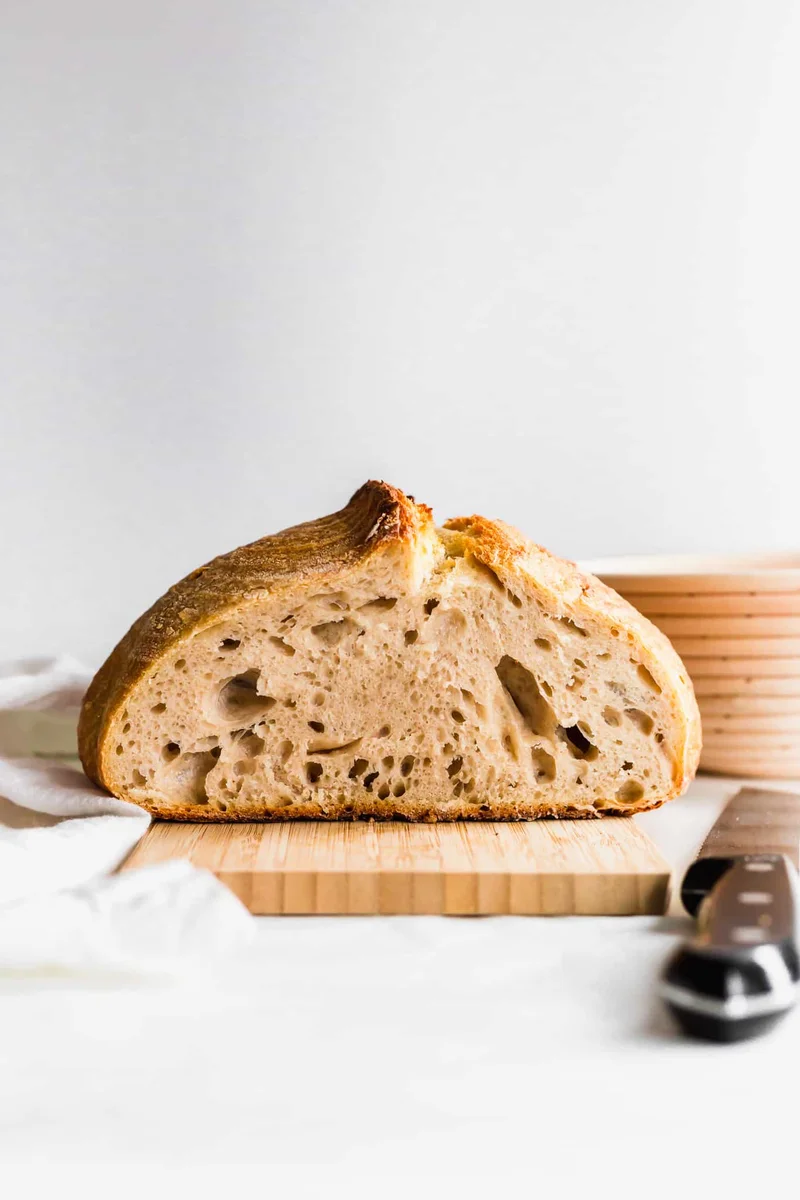
My go-to recipe for a lightly tangy sourdough boule.
📝 Ingredients
- 100 g sourdough starter
- 325 g water (filtered, room temperature)
- 25 g warm water (for dissolving the salt)
- 500 g all-purpose flour (or bread flour)
- 9 g sea salt
- rice flour (for dusting)
👨🍳 Instructions
- 1--- Maintaining Starter: ---
- 2Bring sourdough starter to room temperature one or two nights before you want to make bread.
- 3Remove about half of the starter (save it for pancakes, or another recipe) and feed the remaining starter with 40g water and 40g flour.
- 4Leave it to ferment overnight, until it doubles in size. Repeat each day until the bubbles in the starter are nice and active.
- 5When you remove starter for baking, remember to feed it an equal amount of flour and water.
- 6If you’re not planning to bake, place the fed starter into the fridge. You can keep the starter in the fridge for weeks, but it’s best to take it out and feed it once a week or so.
- 7--- Method: ---
- 8Once the starter is bubbly and active, remove 100g sourdough starter and place into a large bowl.
- 9Add in 325g of water and 500g all-purpose flour to the starter.
- 10Give it a mix and cover with plastic wrap. In the meantime, microwave the 25g of water and add 9g salt and give it a stir to dissolve. Set aside.
- 1130 minutes later, add in the salt water to the flour mixture. Use a spatula or your hands to give the dough a few kneads. Cover again and let rest.
- 12Once every 30 minutes, give the dough a few stretches and folds with your hands. (Best way to do this is to wet your hands and pull the dough up gently; rotate the bowl 90 degrees and repeat).
- 13Do this for the next 2 hours (for a total of 4 sets of stretches and folds) and then cover the dough, and set aside to bulk ferment.
- 14My bulk fermentation for a dough around 78°F is about 4 hours.
- 15Depending on how warm your kitchen is, this can take anywhere from a few hours to 10-12 hours. (It will rise slower than active dry yeast).
- 16Once the dough feels ready (you can see lots of bubbles on the surface), and has increased in volume (but not necessarily double in size) it is time to shape.
- 17Transfer the dough to a well-floured surface, and pinch the edges together so it becomes a round ball.
- 18Using a dough scraper, push the edge of one side of the dough to create a bit of tension. Repeat with the opposite edge (eg. North to South, South to North) and then then East to West and West to East.
- 19Place the dough seam side up into a banneton dusted with rice flour (my banneton is 6" in diameter). Cover with plastic wrap and let it rest at room temperature for 30 minutes.
- 20Move the dough into the refrigerator to proof overnight (cold ferment).
- 21In the morning, preheat a Dutch oven/cast iron pot with cover to 500°F/260°C for at least 30 mins to 1 hour.
- 22Remove the dough from the fridge, and transfer onto a piece of parchment paper. Remove the banneton.
- 23Score the top of the dough at a 45° with a sharp knife (this gives the bread a weak point for the steam to escape).
- 24Carefully remove the hot dutch oven pot from the oven (use gloves) and place the dough into the pot with the parchment paper. Cover with the lid.
- 25Place it into the oven and bake at 500°F/260°C for 20 minutes.
- 26Reduce the temperature to 400°F/204°C and bake for another 30 minutes.
- 27Let completely cool before slicing. (Cool for at least 3-4 hours).
About the Chef & Original Recipe
This recipe was published by Michelle on siftandsimmer.com. Visit the original source for step-by-step photos, chef notes and additional details.
Source: siftandsimmer.com